AI Overview vs AI Mode: two answers, two sets of sources
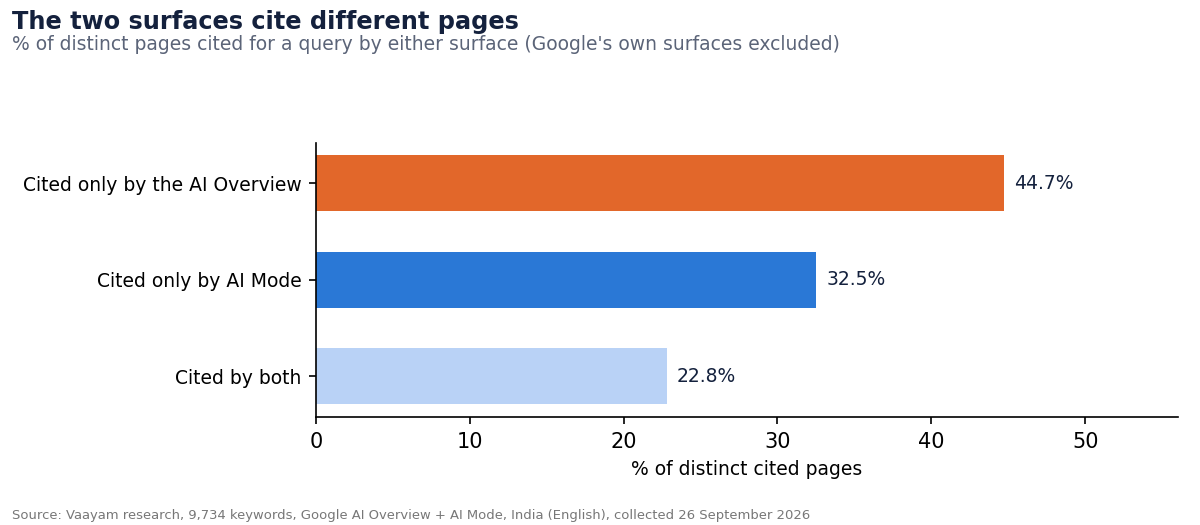
Google now answers the same question in two places, and the answers do not match. We compared the AI Overview and the AI Mode answer for the same keywords in India. Only 22.8% of the pages they cite are the same.

Vaayam research | Part 8 of a series
Most teams talk about "AI search" as if it were one thing. It is not. Google shows an AI Overview on the results page and offers AI Mode as a separate, longer experience. In earlier posts we looked at how AI-written answers replaced featured snippets, whether rankings predict AI visibility, and the anatomy of an AI Mode answer. This post puts the two surfaces side by side. About 8,060 of our 9,734 keywords have both an AI Overview and an AI Mode answer, so we can compare them keyword by keyword.
Key findings
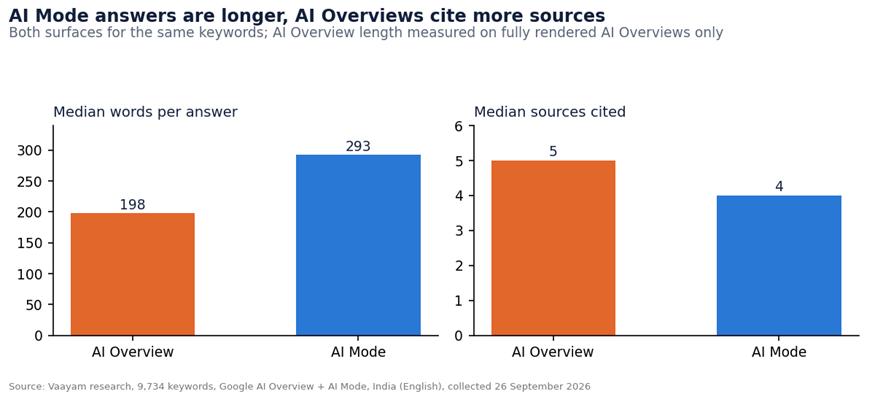
- AI Mode answers are longer: a median of 293 words against 198 for AI Overviews. AI Overviews cite 5 sources at the median and AI Mode cites 4.
- The two surfaces cite different pages: 44.7% of distinct cited pages appear only in the AI Overview, 22.8% in both and 32.5% only in AI Mode.
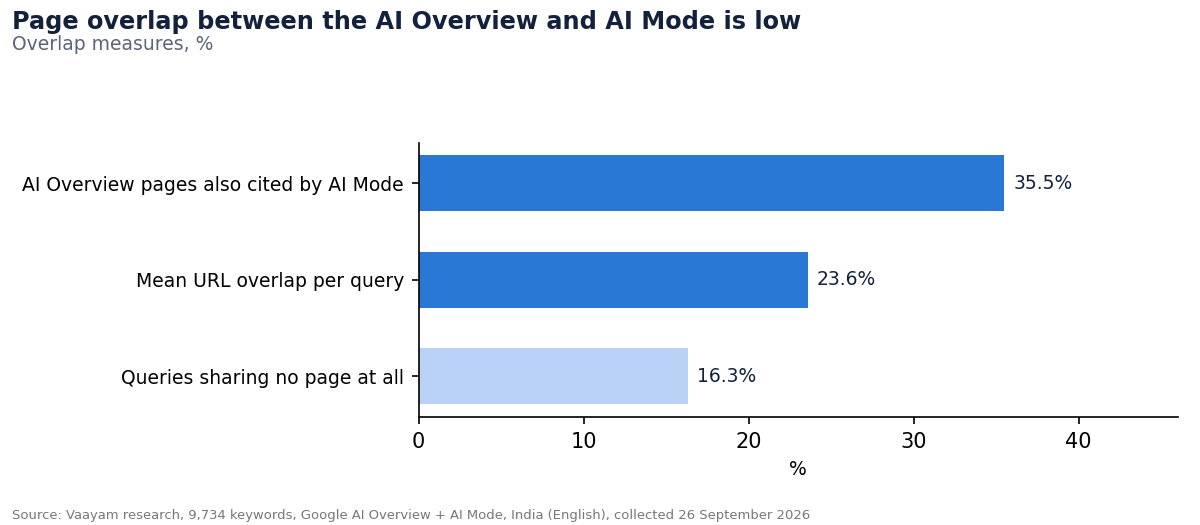
- Only 35.5% of the pages an AI Overview cites are also cited by AI Mode. The mean URL overlap is 23.6%, and 16.3% of queries share no page at all.
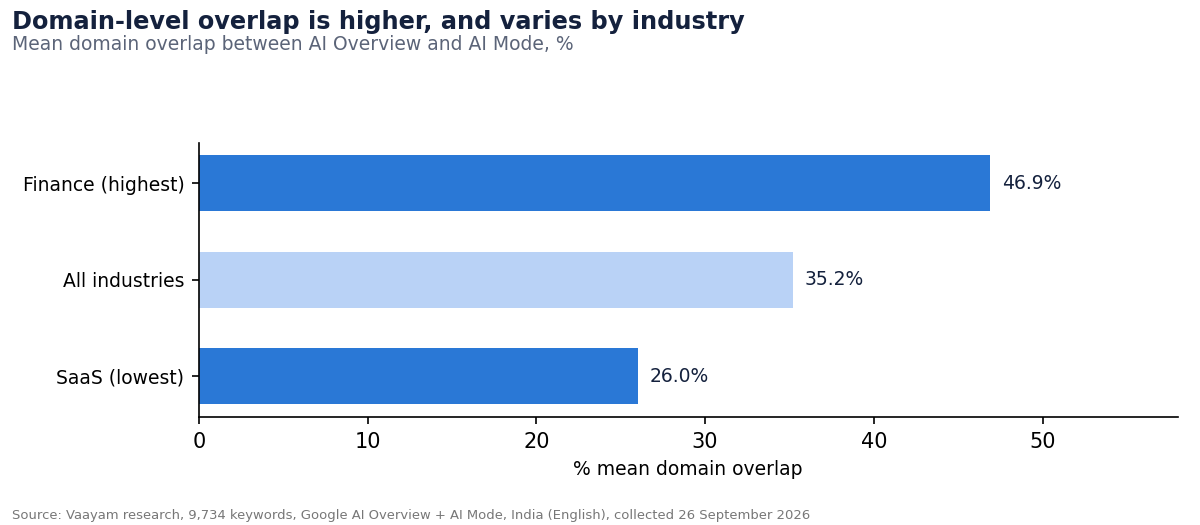
- At domain level, overlap averages 35.2%. Finance has the most (46.9%) and SaaS the least (26.0%).
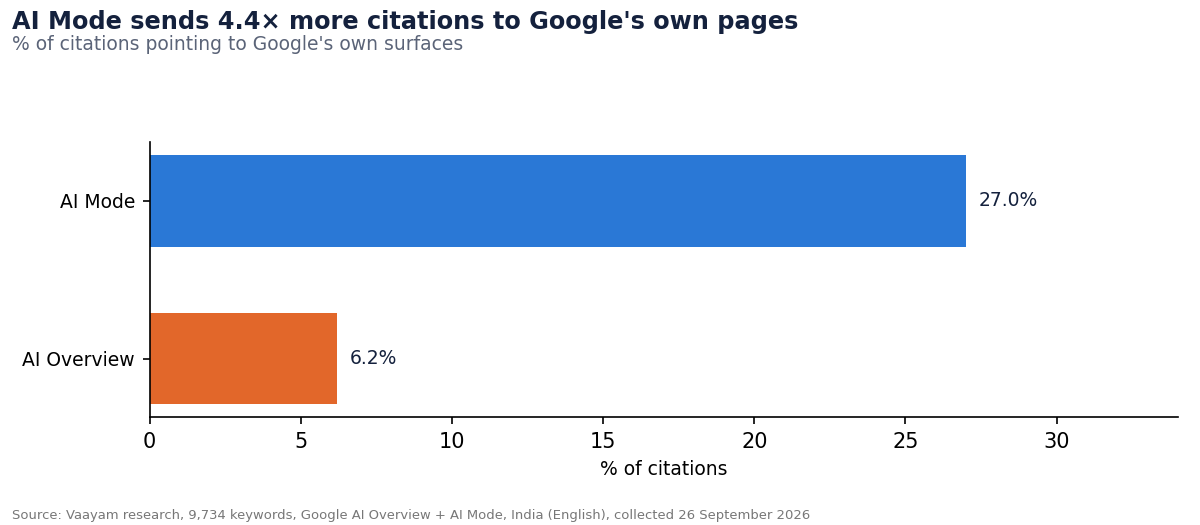
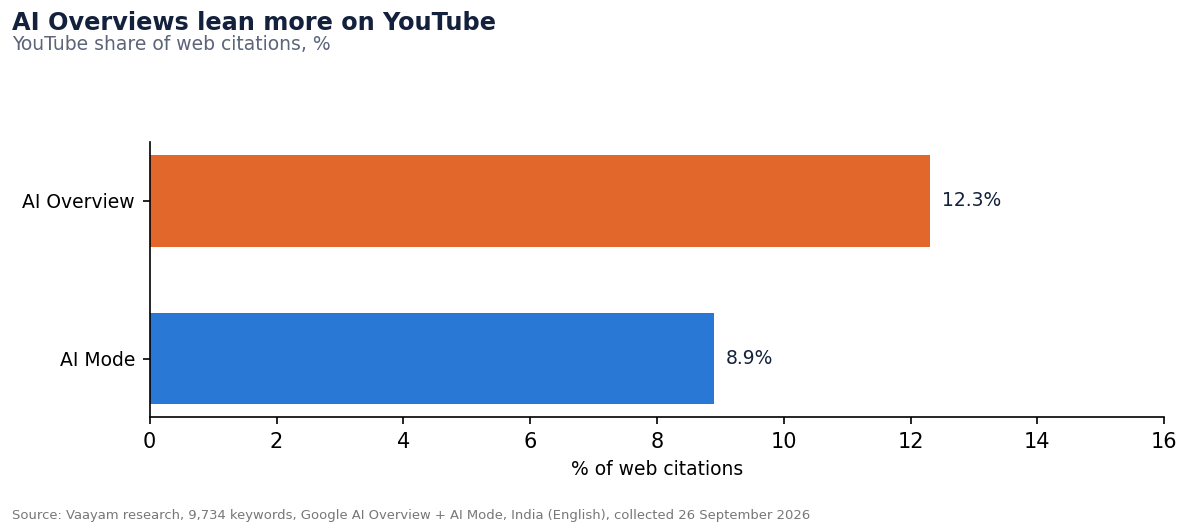
- AI Mode sends 27.0% of its citations to Google's own pages, against 6.2% for AI Overviews (4.4×). AI Overviews lean more on YouTube (12.3% of web citations vs 8.9%).
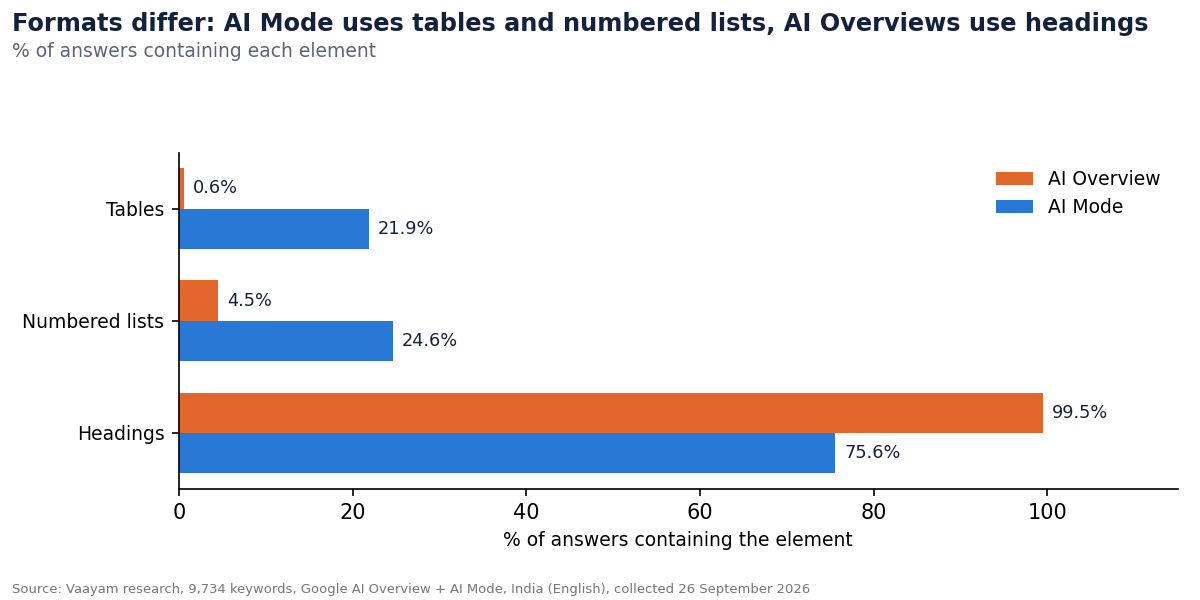
- Formats differ: AI Overviews rarely use tables (0.6% vs 21.9% for AI Mode) or numbered lists (4.5% vs 24.6%), but almost always use headings (99.5%).
1. AI Mode answers are longer, but AI Overviews cite more sources
The median AI Mode answer runs 293 words. The median AI Overview runs 198 words, measured on the roughly 5,840 AI Overviews that rendered fully. Yet AI Overviews cite more sources at the median, 5 against 4 for AI Mode. The shorter answer pulls from more places, and the longer one pulls from slightly fewer. Optimising for one length of answer will not automatically fit the other.
2. The two surfaces cite largely different pages
Looking at every distinct page cited for a query by either surface, with Google's own surfaces excluded, 44.7% are cited only by the AI Overview, 32.5% only by AI Mode and just 22.8% by both. Most of the pages that earn a citation on one surface earn nothing on the other. Being cited in one place is not a reliable sign that you are cited in the other.
3. Page-level overlap is low, and some queries share nothing
Only 35.5% of the pages an AI Overview cites are also cited by AI Mode. Averaged per query, URL overlap is 23.6%, and for 16.3% of queries the two surfaces share no page at all. If you track AI visibility on one surface only, you can miss most of how Google is answering your category.
4. Domain overlap is higher, especially in Finance
The picture is a little less stark at domain level. Averaged across queries, the AI Overview and AI Mode share 35.2% of their cited domains. Finance has the most overlap at 46.9%, which suggests a smaller set of trusted domains answers most money questions. SaaS has the least at 26.0%, so the two surfaces draw on very different sources for software queries.
5. AI Mode sends far more citations to Google itself
AI Mode sends 27.0% of its citations to Google's own pages, such as entity and product cards, against 6.2% for AI Overviews, a 4.4× difference. For local and product categories, a presence on Google's own surfaces matters much more in AI Mode than in the AI Overview.
6. AI Overviews lean more on YouTube
YouTube accounts for 12.3% of web citations in AI Overviews, against 8.9% in AI Mode. Video is a stronger route into the AI Overview than into AI Mode, though it is a major source in both.
7. The two surfaces format answers differently
AI Overviews almost never use tables (0.6%, against 21.9% for AI Mode) or numbered lists (4.5%, against 24.6%). They almost always use headings (99.5%, against 75.6% for AI Mode, from our earlier analysis of AI Mode answers). In practice, AI Mode is more likely to produce comparison tables and step-by-step lists, and the AI Overview is more likely to produce short sections under clear headings.
What to do with this data
Track the AI Overview and AI Mode separately for each priority keyword, because winning one does not predict the other. For AI Overviews, use clear headings and concise sections and consider video, where YouTube is a larger share of citations. For AI Mode, add comparison tables and numbered steps where they genuinely help, and keep your Google Business Profile and Shopping data current, since 27.0% of AI Mode citations go to Google's own pages.
Check your category's overlap. In Finance, where domain overlap is highest, a strong position with the trusted domains helps on both surfaces. In SaaS, where overlap is lowest, treat the two surfaces as separate channels with separate content plans.
Report AI visibility as two metrics, not one. With only 22.8% of cited pages shared and 16.3% of queries sharing no page, a single combined number can hide a gap. These findings come from a one-day correlation snapshot, so validate them against your own category before moving budget.
Read the rest of the series
Featured snippets are gone: Google's AI writes the answer now - where Google's on-page answers come from in India.
Do Google rankings predict AI visibility? - how organic rank relates to AI Mode citations.
Anatomy of a Google AI Mode answer in India - length, structure, sources and ads in AI Mode answers.
Method and limits
The dataset covers 9,734 keywords across 10 industries, captured on one day, 26 September 2026, for India in English on desktop. About 8,060 keywords have both an AI Overview and an AI Mode answer, and AI Overview length is measured on the roughly 5,840 that rendered fully. Page overlap excludes Google's own surfaces. The capture is a non-personalised snapshot, so individual users may see different answers. Every finding is a correlation and none show causation.