Do Google rankings predict AI visibility?
Ranking #1 helps. It does not guarantee you a citation, and it is far from the whole story. We matched 9,734 keywords' organic rankings against what Google's AI Mode actually cites, and found a system that rewards rank, but not nearly as tightly as SEOs assume.

Vaayam research | Data collected 26 September 2026 | Part 4 of a series
So far in this series, we've shown that the ten blue links are mostly gone, that every industry gets a different Google, and that search intent reshapes the page again. This post asks the question every SEO and brand team actually wants answered: does ranking well on Google still get you cited by Google's AI? We matched organic rankings to AI Mode citations across 9,734 keywords to find out, and the honest answer is "partly."
Key findings
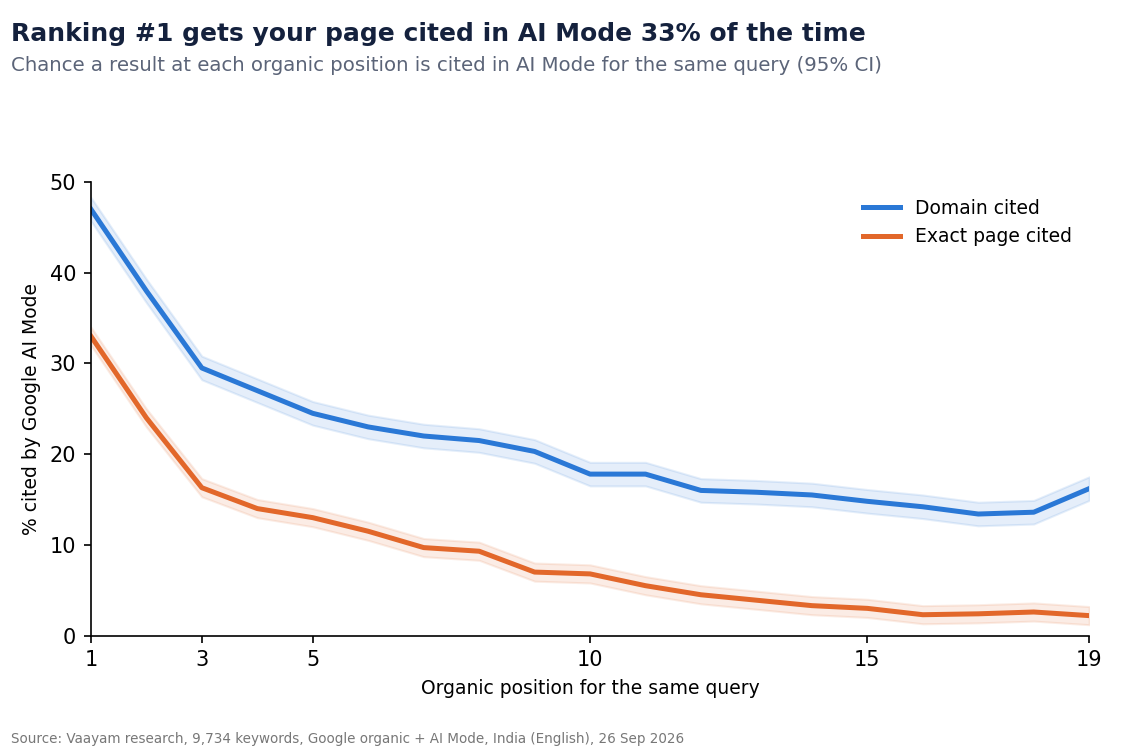
- If a page ranks #1, AI Mode cites that exact page 33% of the time, and cites its domain 47% of the time.
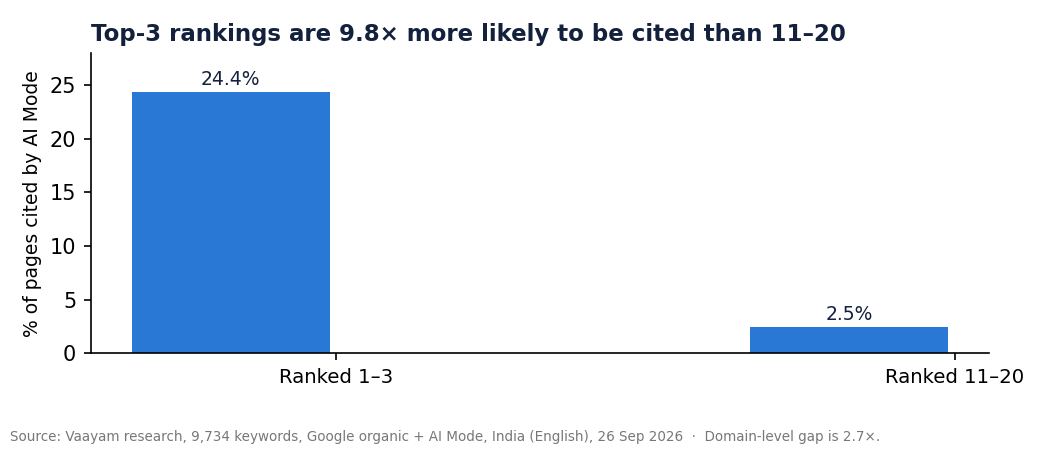
- A page ranked 1-3 is 9.8× more likely to be cited than one ranked 11-20 (24.4% vs 2.5%). At the domain level, the gap is 2.7×.
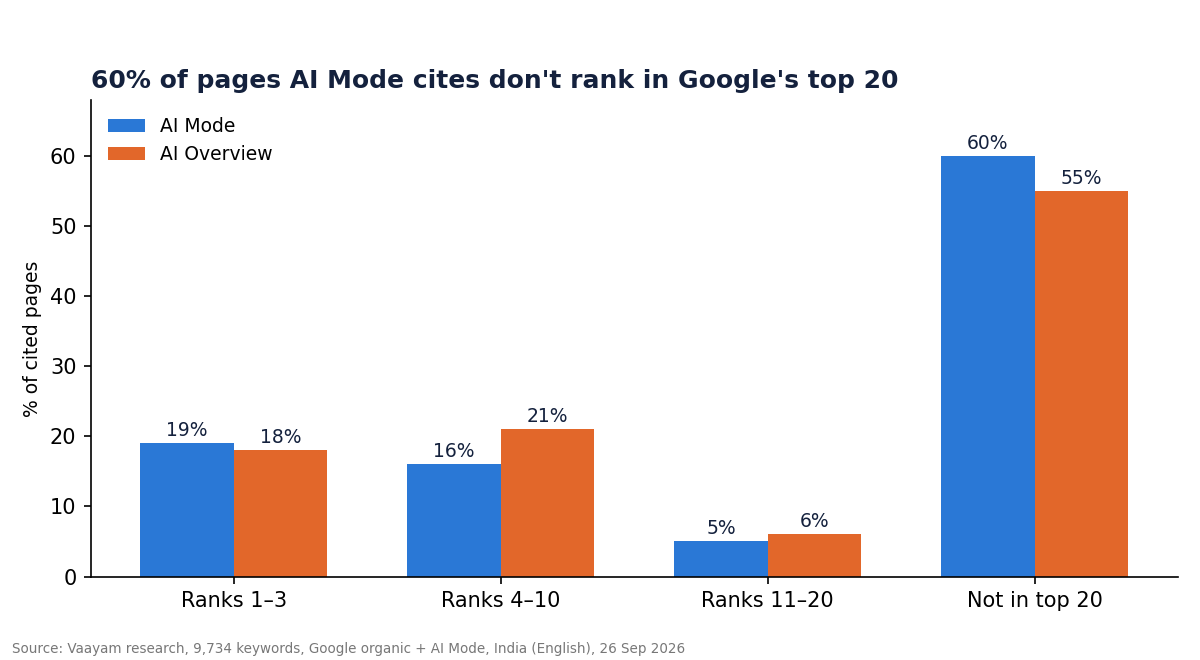
- But 60% of the pages AI Mode cites don't rank in the organic top 20 for that query. At the domain level, the figure is 36%.
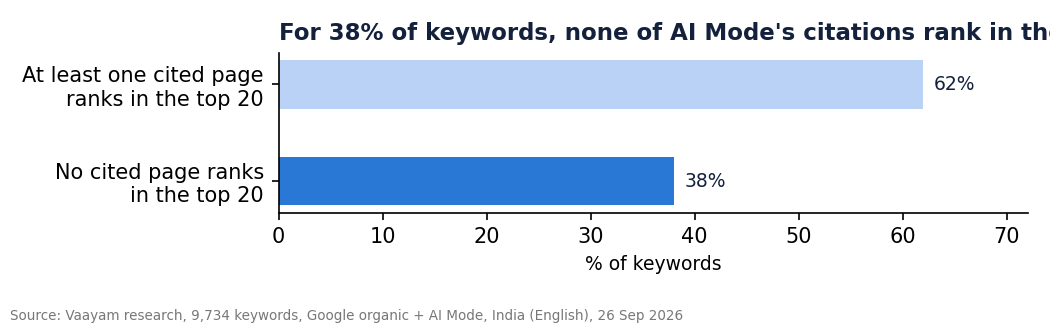
- For 38% of keywords, none of the cited pages rank in the top 20 at all.
- AI Overviews stay closer to the organic results than AI Mode: 55% of the pages they cite sit outside the top 20, against 60%.
1. Rank #1 gets you cited about a third of the time
If a page holds the #1 organic position, AI Mode cites that exact URL 33% of the time, and cites something from its domain 47% of the time. Citation rate falls steadily and predictably as rank drops; the correlation between position and citation rate is close to perfectly monotonic. Being first is clearly an advantage. It is not a guarantee.
2. Top-3 rankings are worth chasing: the citation gap is nearly 10×
A page ranked 1-3 is cited 24.4% of the time, against 2.5% for a page ranked 11-20, a 9.8× gap. At the domain level, the gap is smaller but still real, 2.7×. For SEO teams prioritising a finite content budget, this is the clearest signal in the dataset: moving from page 2 into the top 3 still measurably increases your odds of being cited, even in an AI-first results page.
3. Most citations still come from outside Google's own top 20
Here is the part that should change how brand teams think about AI visibility: 60% of the pages AI Mode cites don't rank in the organic top 20 for that query at all. At the domain level, 36% of cited domains don't rank in the top 20. AI Overviews are slightly more conservative, staying closer to the organic results: 55% of their citations fall outside the top 20, against AI Mode's 60%. Either way, more than half of AI citation opportunity sits outside what a traditional rank tracker would ever show you.
4. More than a third of keywords get no citation from a top-20 page at all
For 38% of keywords in our sample, none of the pages AI Mode cited rank anywhere in Google's organic top 20. That means for roughly two in five searches, ranking well, even dominating page 1, would not have been enough to appear as a cited source. Some other signal, outside classic organic ranking, is driving which pages AI Mode reaches for.
What to do with this data
Keep chasing top-3 rankings: the 9.8× citation lift is real, but stop treating rank as a proxy for AI visibility. Build a separate tracking view for AI Mode and AI Overview citations per keyword, since a page can win the citation without holding the rank, and vice versa.
Audit your most important keywords for citation specifically, not just position. If you're not ranking in the top 20 at all, you still have a real shot at citation: 36% of cited domains aren't in the top 20, so don't write off AI visibility just because organic rank is weak.
Budget for both motions as separate line items. Rank-building and citation-building correlate but are not the same investment, and 38% of your keywords may need a citation-specific push that rank alone will never solve.
Read the rest of the series
Part 1: The 10 blue links are almost gone: why only 4.8% of Google page 1s in India still show ten organic results.
Part 2: Every industry gets a different Google: how Feature Density and specific SERP features vary by industry.
Part 3: Google builds a different page for each intent: how informational, commercial, transactional, and navigational searches each get a different page.
Method and limits
The dataset covers 9,734 keywords with matched Google organic results (depth 20) and AI Mode answers, collected on 26 September 2026 for India in English on desktop. This is a correlation study and says nothing about causation. Results are a non-personalised snapshot on a single day so individual users may see something different.