Do brands own their name in Google AI Mode? Finance does. Ecommerce doesn't.
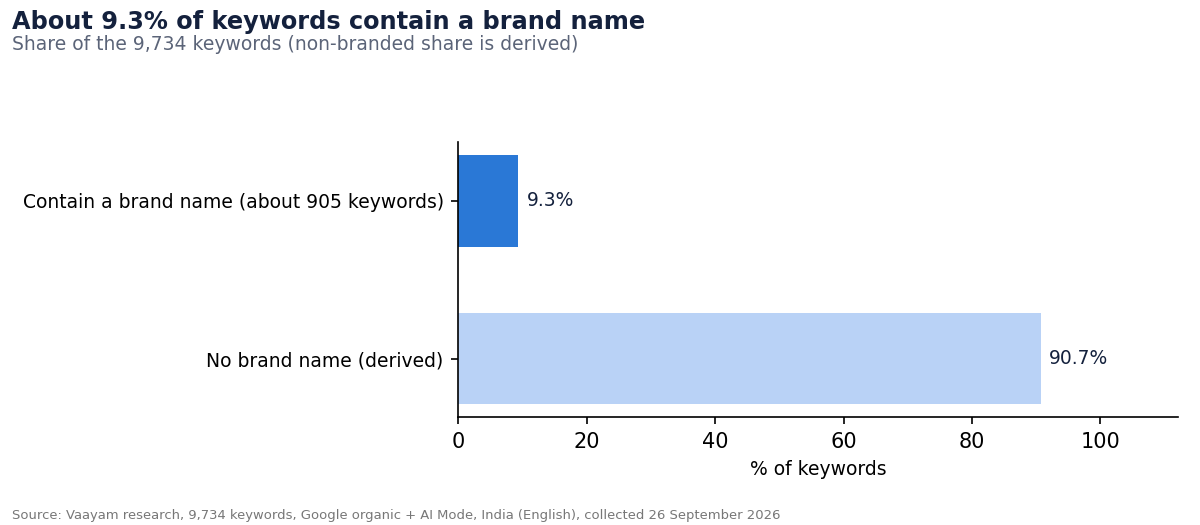
Ranking #1 for your own brand name sounds like a safe position. We checked what happens in Google AI Mode for about 905 branded searches across a dataset of 9,734 keywords in India. Some brands are cited almost every time. Others are rarely cited on their own name.

Vaayam research | Part 9 of a series
Branded searches are the most valuable searches a company has: the person already knows the name and wants to find, compare or act. In earlier posts we compared the AI Overview and AI Mode, showed that AI-written answers have replaced featured snippets, and mapped the anatomy of an AI Mode answer. This post asks a simple question: when someone searches for a brand by name, does Google AI Mode cite that brand's own website? About 9.3% of our keywords contain a brand name, for example "hdfc home loan" or "philips air fryer".
Key findings
- About 9.3% of the sample (roughly 905 of 9,734 keywords) contains a brand name.
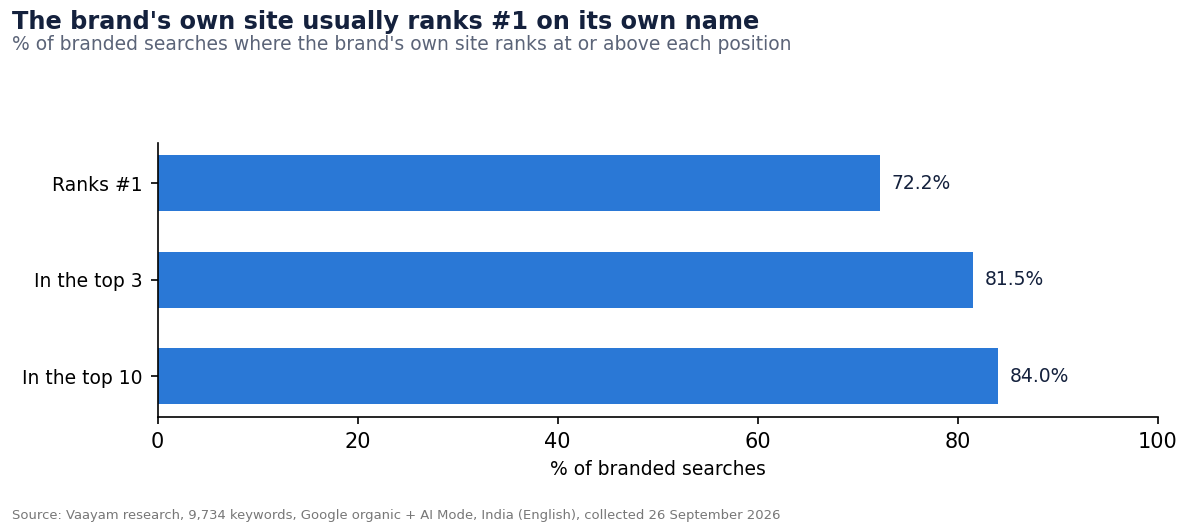
- On these searches the brand's own site ranks #1 on 72.2%, is in the top 3 on 81.5% and in the top 10 on 84.0%.
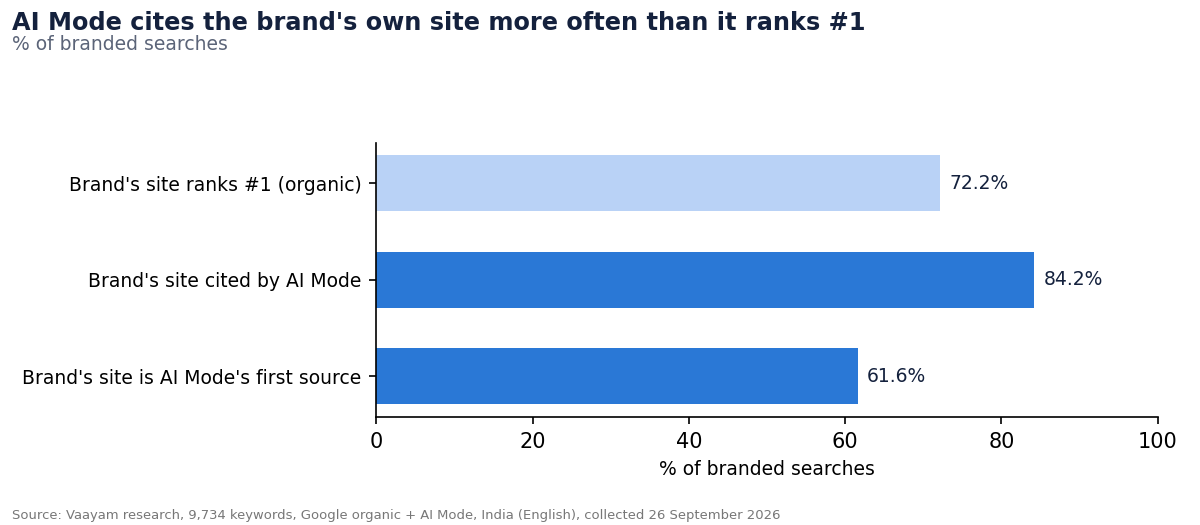
- AI Mode cites the brand's own site on 84.2% of branded searches and makes it the first source on 61.6%.
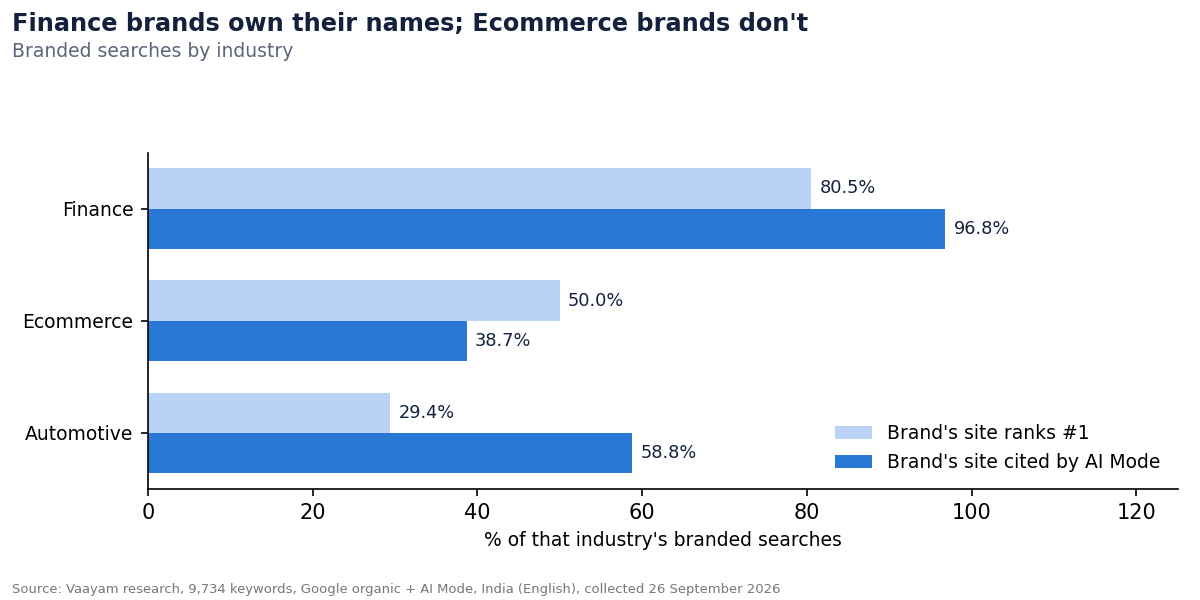
- Finance brands own their names: #1 on 80.5% of branded searches and cited on 96.8%. HDFC is cited on 98.9% of its branded searches and ICICI on 100%.
- Ecommerce brands don't: #1 on 50.0% and cited on only 38.7%. Philips is cited on 41.5%. Automotive brands rank #1 on 29.4% and are cited on 58.8%, with Hyundai at 43.8%.
- 10.3% of brands that rank #1 are still not cited by AI Mode. When the brand isn't cited, the sources most often cited instead are CarWale, CarDekho and YouTube.
1. About one keyword in ten is a branded search
Of the 9,734 keywords, about 9.3% (roughly 905) contain a brand name, such as "hdfc home loan" or "philips air fryer". These are a small share of search volume in our sample but a high-intent one: the searcher has already chosen the brand and is looking for a product, a service or a task such as a download or a settlement process.
2. The brand's own site ranks #1 on most branded searches
On branded searches, the brand's own site ranks #1 on 72.2%, in the top 3 on 81.5% and in the top 10 on 84.0%. In other words, for roughly one branded search in six, the brand's own site is not even on page 1. Owning your name in classic organic results is common but not guaranteed.
3. AI Mode cites the brand more often than it ranks it #1
AI Mode cites the brand's own site on 84.2% of branded searches, and makes it the first source on 61.6%. That is a higher citation rate than the 72.2% #1 organic rate, which suggests AI Mode sometimes cites a brand that does not rank first. It also means that on roughly one branded search in six, AI Mode does not cite the brand's own site at all.
4. Finance brands own their names. Ecommerce and Automotive brands don't.
The averages hide a large gap by industry. Finance brands rank #1 on 80.5% of about 450 branded searches and are cited by AI Mode on 96.8%. Ecommerce brands rank #1 on 50.0% and are cited on only 38.7% (about 127 searches). Automotive brands rank #1 on 29.4% of their branded searches and are cited on 58.8%. In ecommerce and automotive, comparison sites, marketplaces and video fill the answer, while in finance the official brand site is the answer.
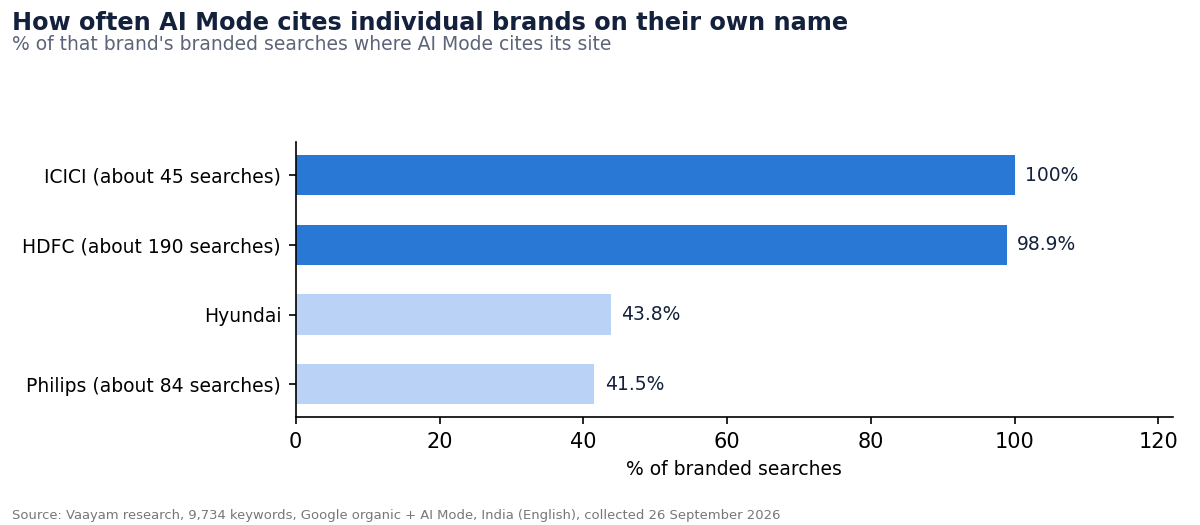
The pattern holds at brand level. HDFC is cited on 98.9% of its roughly 190 branded searches and ICICI on 100% of about 45. Philips is cited on 41.5% of its roughly 84, and Hyundai on 43.8%.
5. One in ten brands that rank #1 are still not cited
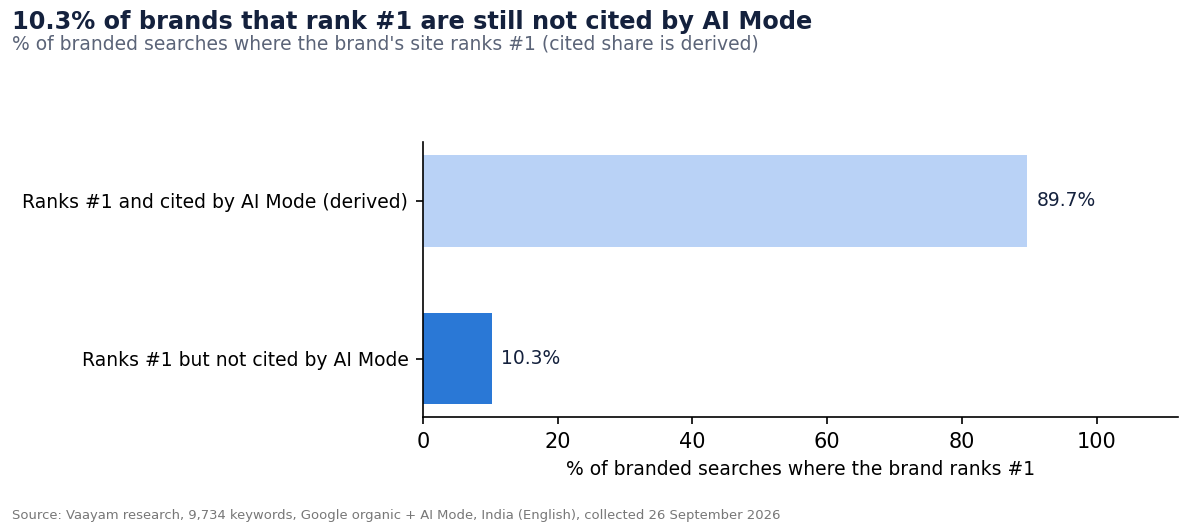
Ranking #1 is not enough. 10.3% of brands that rank #1 on their own name are still not cited by AI Mode. Examples include "sbi credit card settlement process" and "sbi home loan interest certificate download". These are task-style queries where the answer needs a clear explanation of a process, and a brand page that merely ranks does not always supply it.
6. When the brand isn't cited, comparison sites and YouTube step in
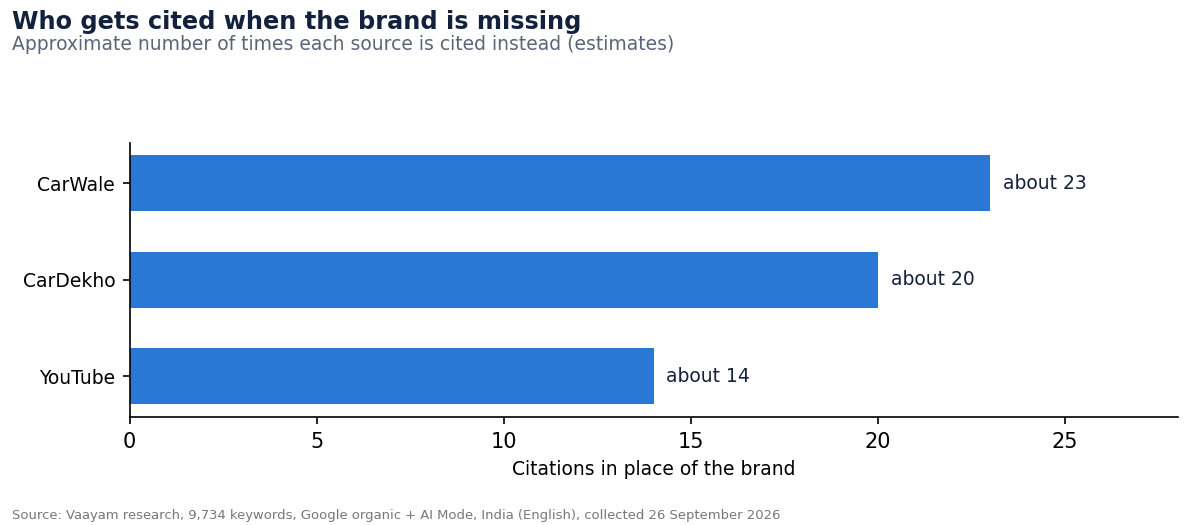
When AI Mode does not cite the brand's own site, the most common sources it cites instead are CarWale (about 23 times), CarDekho (about 20) and YouTube (about 14). These are marketplaces, comparison portals and video, which already hold a strong position in AI Mode, as our domain analysis showed. A brand that leaves a gap in its own content is leaving it for them.
Takeaways
Audit your branded queries in AI Mode, not just your rankings. For each branded keyword, check whether AI Mode cites your own site, and prioritise the task queries where you rank #1 but are not cited, such as "how to", "download" and "process" searches. Give those pages a clear, self-contained answer with steps, since a ranking alone did not guarantee a citation.
Measure your own branded citation rate. If you are in Ecommerce or Automotive, expect marketplaces, comparison sites and video to compete for your name, and publish the product specifications, comparisons and videos yourself so the answer can come from you. If you are in Finance, protect the position you already have by keeping product and process pages current.
Add branded AI Mode citation rate to the reporting alongside branded rank and branded traffic. A brand can hold #1 and still lose the answer. These findings come from a one-day correlation snapshot, so validate them against your own brand before changing budgets.
Read the rest of the series
AI Overview vs AI Mode: two answers, two sets of sources — how the two AI surfaces cite different pages.
Featured snippets are gone: Google's AI writes the answer now — where Google's on-page answers come from in India.
Anatomy of a Google AI Mode answer in India — length, structure, sources and ads in AI Mode answers.
Method and limits
The dataset covers 9,734 keywords across 10 industries, captured on one day, 26 September 2026, for India in English on desktop. Branded searches are keywords that contain a brand name, and the brand's own site means the brand's official domain. The capture is a non-personalised snapshot, so individual users may see different results. Keywords come from keyword research around some sample seed terms per industry, so they represent those neighbourhoods, not all Indian search. Brand and industry results rest on smaller samples than the overall figures. Every finding is a correlation and none show causation.