AI search demand in India: what people ask AI per 100 Google searches
For every 100 searches on Google, how many are estimated to happen in AI? We compared AI demand with Google search volume across 4,704 keywords in India. The answer depends heavily on industry, intent and how long the query is.

Vaayam research | Part 15 of our India search research
Earlier posts looked at what AI answers show and cite. This one looks at demand: how much AI search activity exists around a keyword, compared with Google. We estimated AI demand for each keyword and set it against Google search volume. We also looked at which industries win in AI Mode and how Google builds a different page for each intent before; here the question is how much people actually use AI for those same topics.
How we counted keywords
We merged keyword variants that differ only by stop words, which left 4,704 keywords: 4,684 multi-word keywords and 20 single-word topics. Single-word topics behave very differently from the rest, so the figures below that describe typical keywords use the multi-word set only. AI demand figures are estimates, shown as estimated AI searches per 100 Google searches.
Key findings
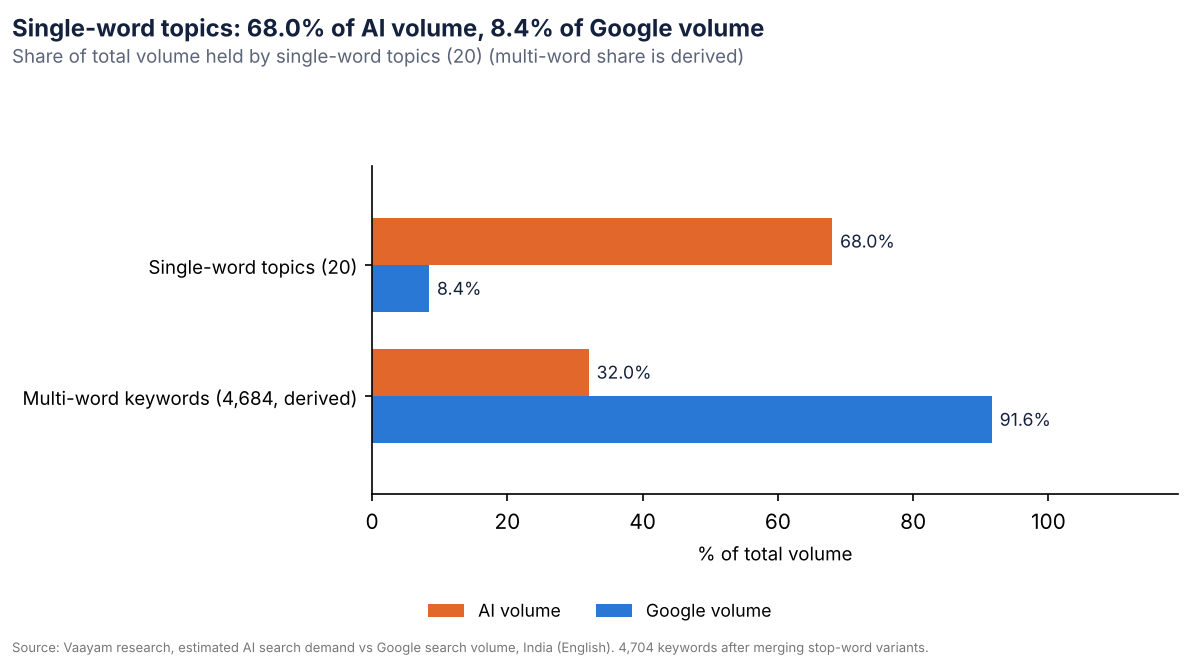
- Single-word topics hold 68.0% of AI volume but only 8.4% of Google volume, so this post leads with multi-word keywords.
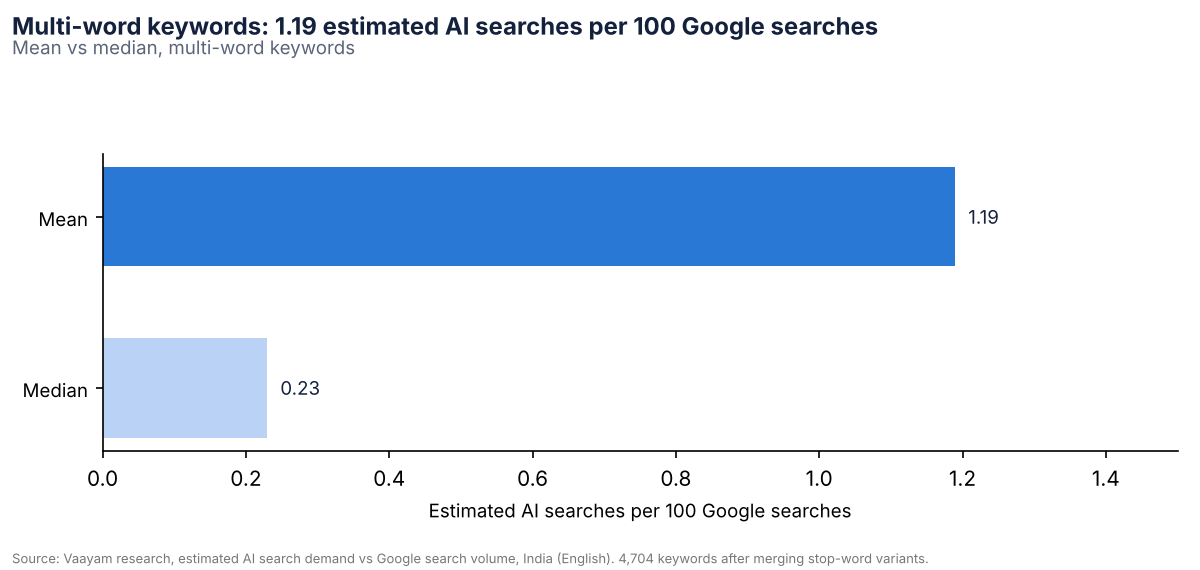
- Multi-word keywords average 1.19 estimated AI searches per 100 Google searches, with a median of 0.23.
- 33.7% of multi-word keywords show no AI demand at all.
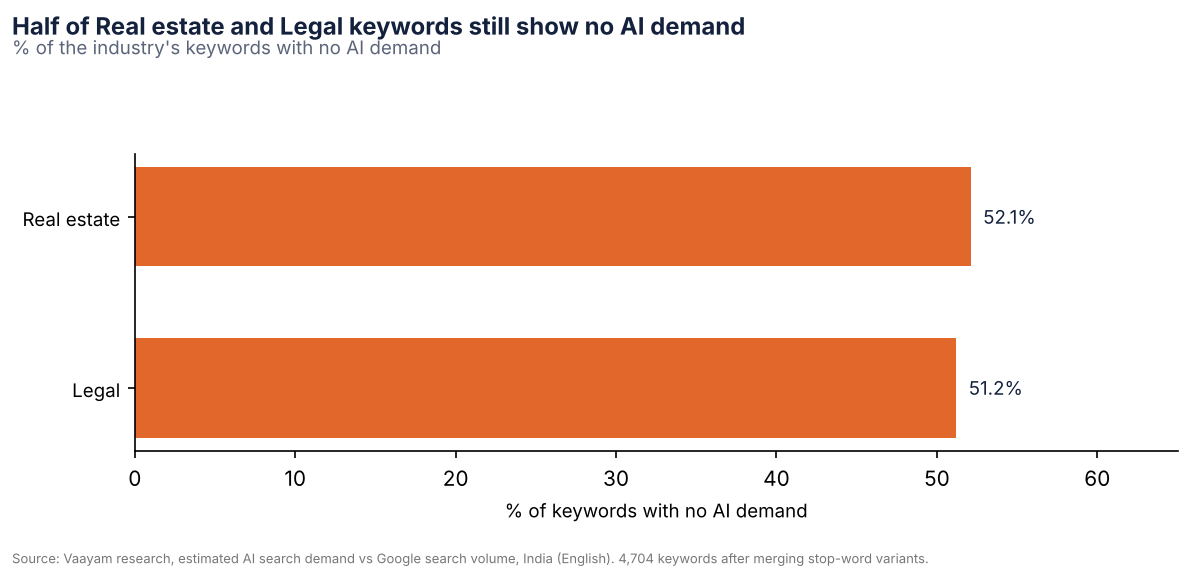
- By industry: Real estate 2.06 per 100, Automotive 1.95 and Travel 1.86; SaaS 0.74 and Ecommerce 0.32. Still, 52.1% of Real estate keywords and 51.2% of Legal keywords show no AI demand.
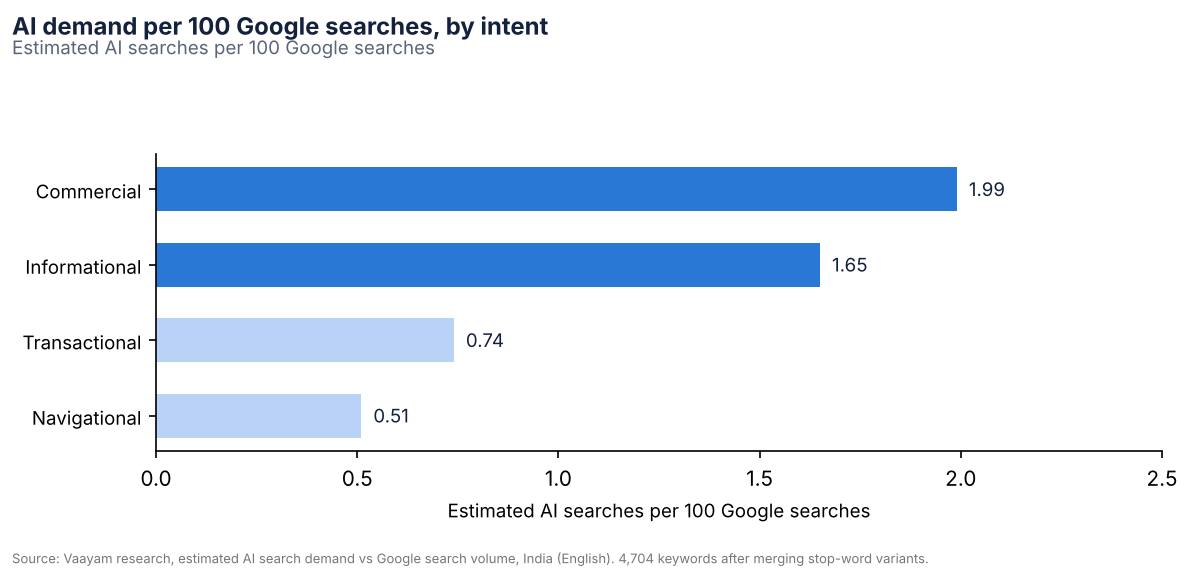
- By intent: commercial 1.99, informational 1.65, transactional 0.74 and navigational 0.51.
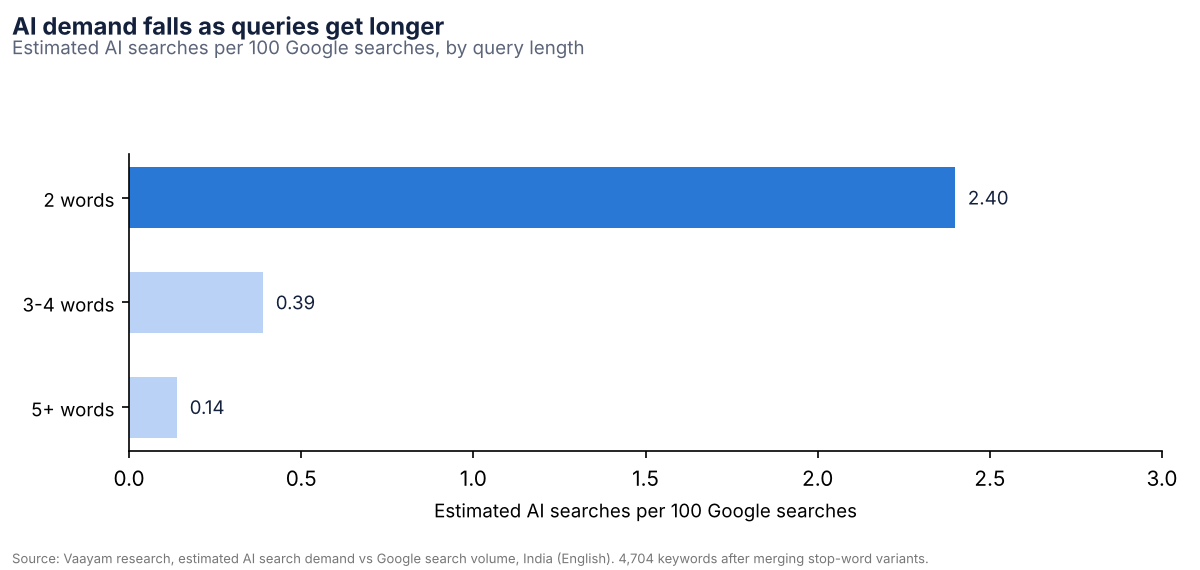
- AI demand falls with query length: 2.40 for two-word queries, 0.39 for 3-4 words and 0.14 for 5+ words.
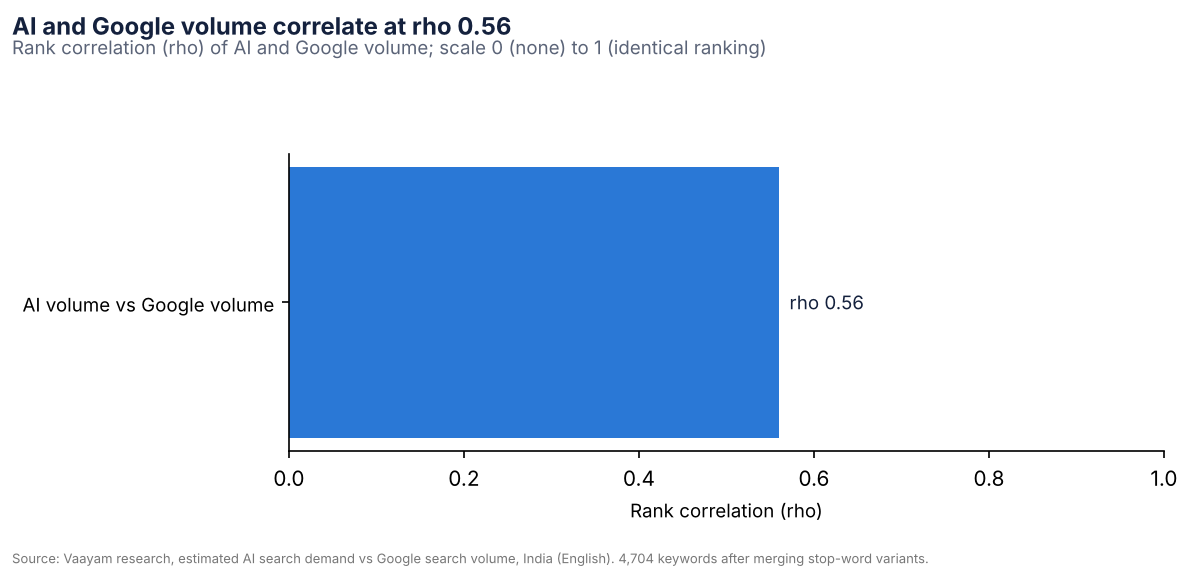
- AI and Google volume correlate at rho 0.56.
1. A few single-word topics distort the picture
The 20 single-word topics hold 68.0% of AI volume but only 8.4% of Google volume. If you average across everything, those few broad topics dominate and make AI demand look much larger than it is for a typical keyword. We set them aside and describe the 4,684 multi-word keywords, which is where most real search targets sit.
2. For a typical keyword, AI demand is small
Across multi-word keywords, the mean is 1.19 estimated AI searches per 100 Google searches. The median is 0.23, far below the mean, which means a small number of keywords carry most of the AI demand while most have very little.
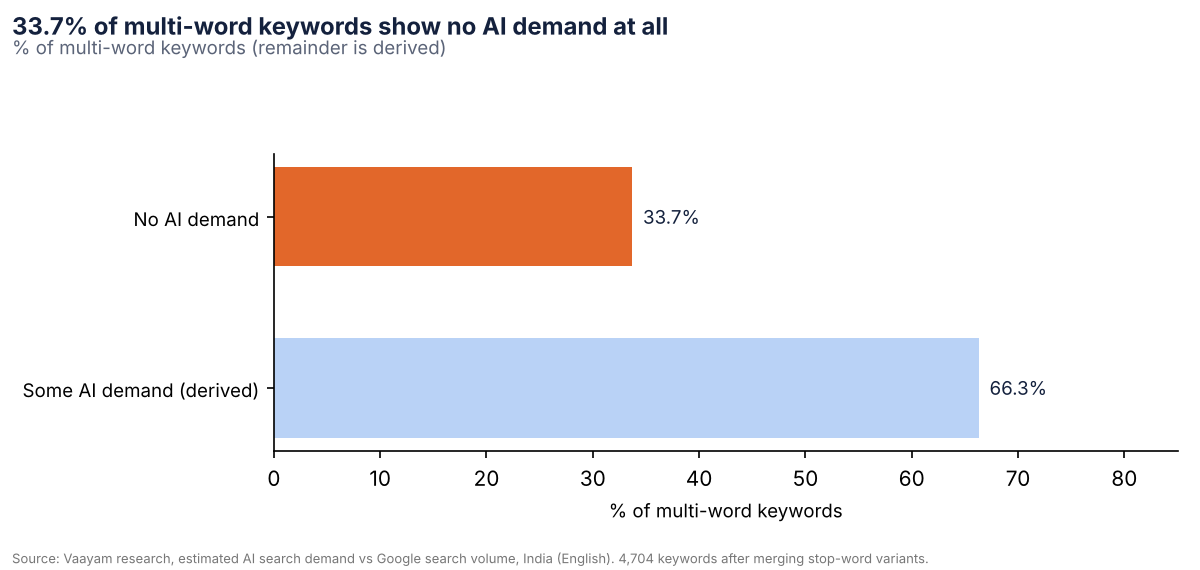
33.7% of multi-word keywords show no AI demand at all. For a third of keywords, Google remains the only place the demand shows up.
3. Real estate, Automotive and Travel lead; Ecommerce trails
By industry, estimated AI demand per 100 Google searches is highest in Real estate (2.06), Automotive (1.95) and Travel (1.86). It is lower in SaaS (0.74) and lowest in Ecommerce (0.32).
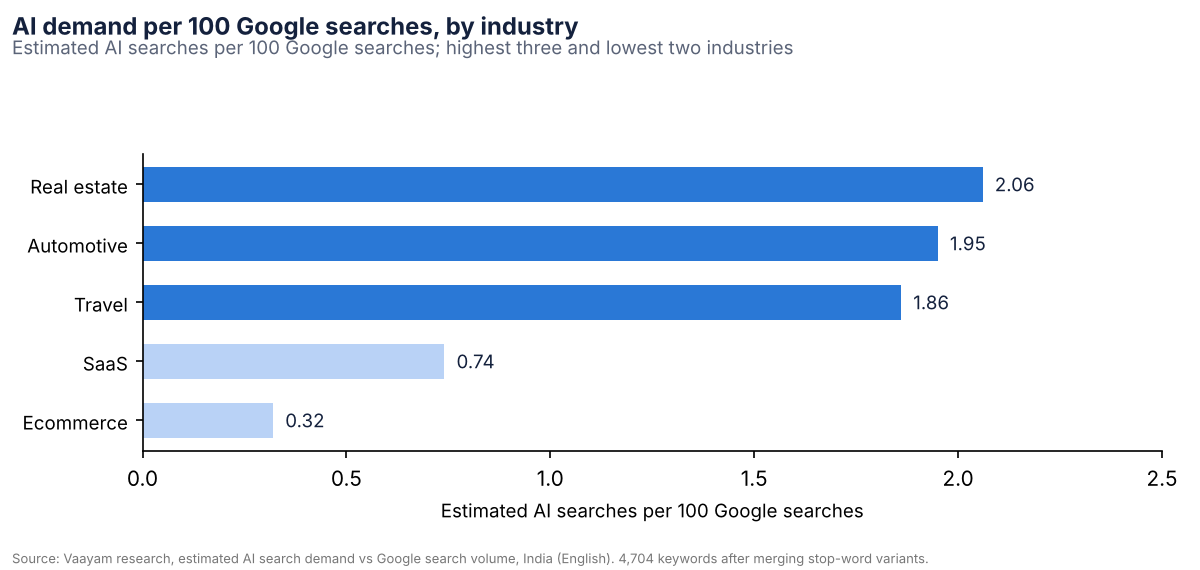
High average demand does not mean every keyword has demand. 52.1% of Real estate keywords and 51.2% of Legal keywords still show no AI demand. Even in the industries with the most AI activity, about half of keywords are not asked in AI.
4. Commercial and informational intent lead
By intent, commercial keywords show 1.99 estimated AI searches per 100 Google searches, informational 1.65, transactional 0.74 and navigational 0.51. AI demand is stronger for researching and comparing than for buying or reaching a known site.
5. Shorter queries show more AI demand
AI demand falls with query length. Two-word queries show 2.40 per 100 Google searches, 3–4 word queries 0.39 and queries of 5+ words 0.14. Long, specific queries show very little AI demand.
6. AI and Google volume move together, loosely
AI and Google volume correlate at rho 0.56. That is a moderate relationship: keywords with high Google volume tend to have higher AI demand, but the match is far from exact, so Google volume alone will not tell you which topics people ask AI about.
Takeways
Do not treat AI demand as a replacement for Google volume. At 1.19 estimated AI searches per 100 Google searches for a typical multi-word keyword, Google still carries almost all of the demand. Review your keyword list for the 33.7% with no AI demand and keep investing in classic search for those, and look for the keywords where AI demand is relatively high, especially short commercial and informational queries.
Check where your category sits. Real estate, Automotive and Travel show the highest AI demand per Google search, so start measuring your visibility in AI answers there first. In Ecommerce, AI demand is lowest (0.32 per 100), so Google and marketplace presence still matter more. Note that rankings and AI visibility are only loosely connected, as our earlier study showed.
Size the opportunity before moving budget. AI demand is real in specific industries and intents, but it is still a small share of Google volume for most keywords. Track estimated AI searches per 100 Google searches as a regular metric by industry and intent, and revisit it each quarter. These figures are estimates and correlations, so test them against your own category data.
Read more from our India search research
Who wins in AI Mode? Share of voice vs AI citations in eight Indian industries - industry differences in AI Mode.
Google builds a different page for each intent - how intent changes the results page.
Every industry gets a different Google - feature density by industry.
Do Google rankings predict AI visibility? - how rank relates to AI citations.
Method and limits
We merged keyword variants that differ only by stop words, leaving 4,704 keywords (4,684 multi-word and 20 single-word topics), and compared estimated AI search demand with Google search volume for India (English). AI demand is an estimate, expressed as estimated AI searches per 100 Google searches. The mean, median, share with no AI demand and breakdowns by industry, intent and query length use the multi-word keywords; the single-word comparison covers the 20 single-word topics. The rank correlation (rho) measures how similarly the two volumes rank keywords. Keywords with no AI demand pull the median down. Industry and intent groups vary in size. Every finding is a correlation, not a causal claim.