ChatGPT and Google AI Mode name the same brands, but cite different pages
If an AI answer names your brand, does it send the reader to your site? We compared brand mentions in ChatGPT and Google AI Mode in India. The two engines talk about similar brands. What they link to is a different story.

Vaayam research | AI Search Compared, Part 2 | Part 14 of our India search research
This is the second post in our AI Search Compared series. In Part 1 we found that ChatGPT and Google AI Mode share only 7.6% of cited pages. This post asks a different question: do they at least talk about the same brands? We also revisit two earlier Google AI Mode findings, whether brands own their own name and how often brands are named but not cited, this time with ChatGPT alongside.
How we counted a brand mention
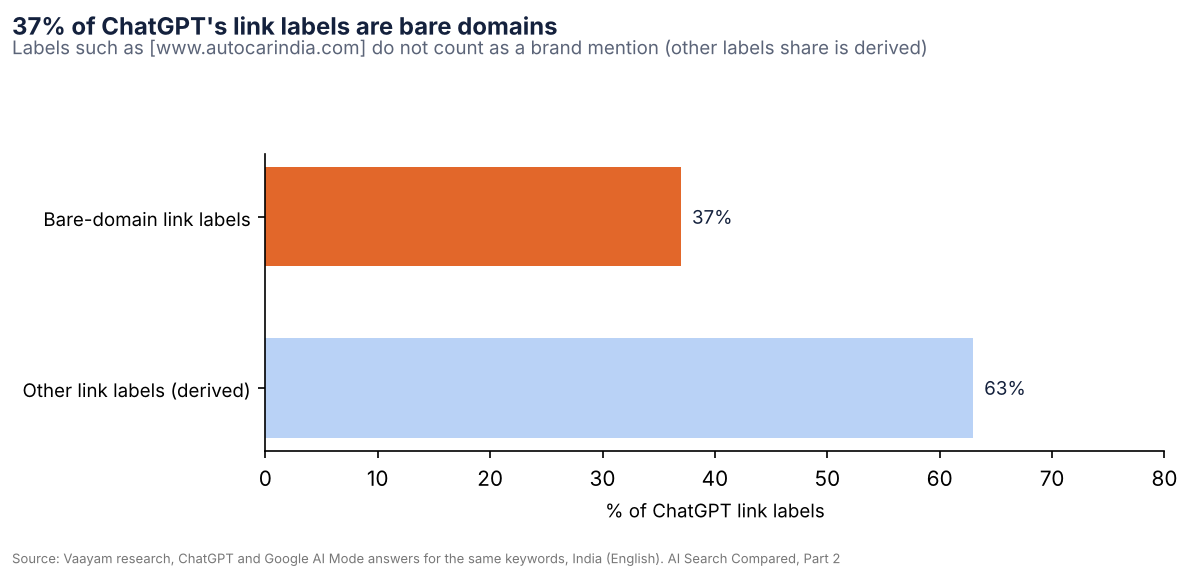
A mention means the brand's name in the answer's own words. Citation labels such as [www.autocarindia.com] do not count. This matters for ChatGPT: 37% of its link labels are bare domains, and counting them had inflated its brand figures. The numbers in this post use the stricter definition, so they are lower than a naive count would give.
Key findings
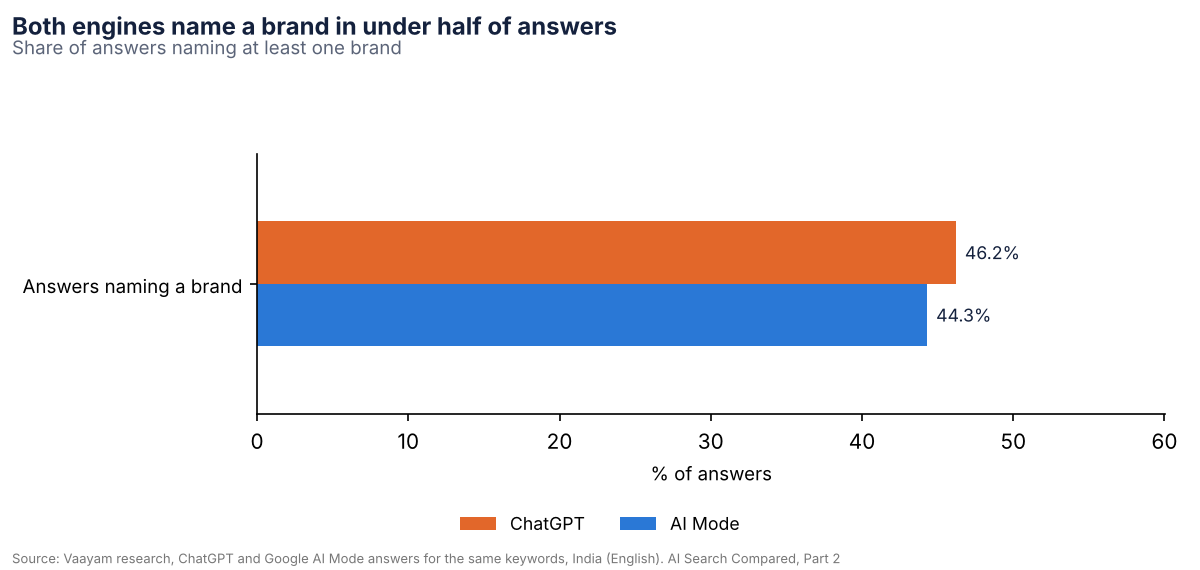
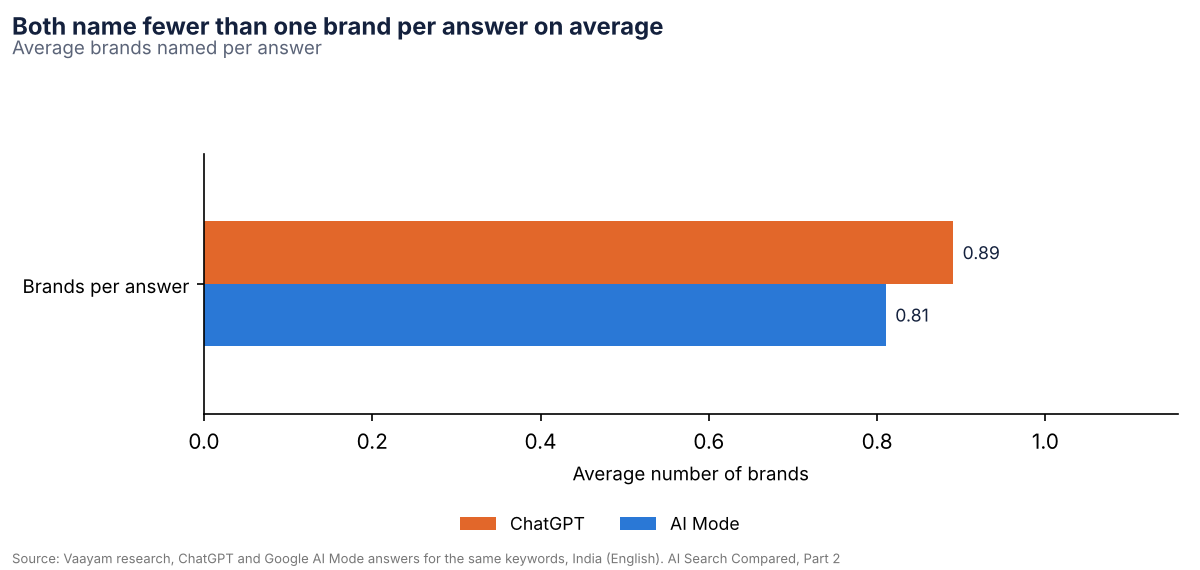
- 46.2% of ChatGPT answers name a brand, against 44.3% for AI Mode. Both name under one brand per answer on average (0.89 and 0.81).
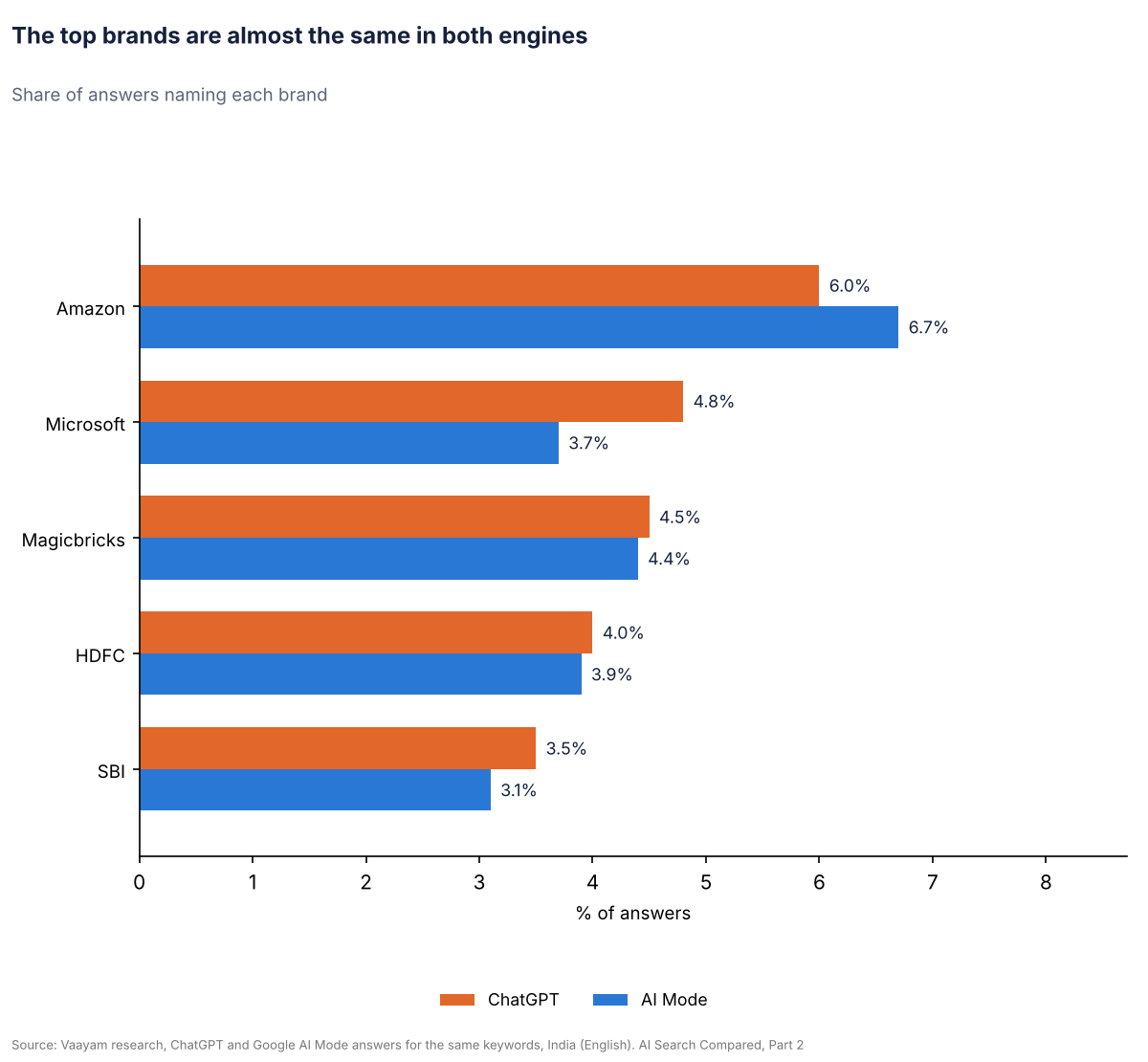
- The top brands are the same: Amazon 6.0%, Microsoft 4.8%, Magicbricks 4.5%, HDFC 4.0% and SBI 3.5% in ChatGPT. AI Mode's figures for the same names are close (6.7%, 3.7%, 4.4%, 3.9% and 3.1%).
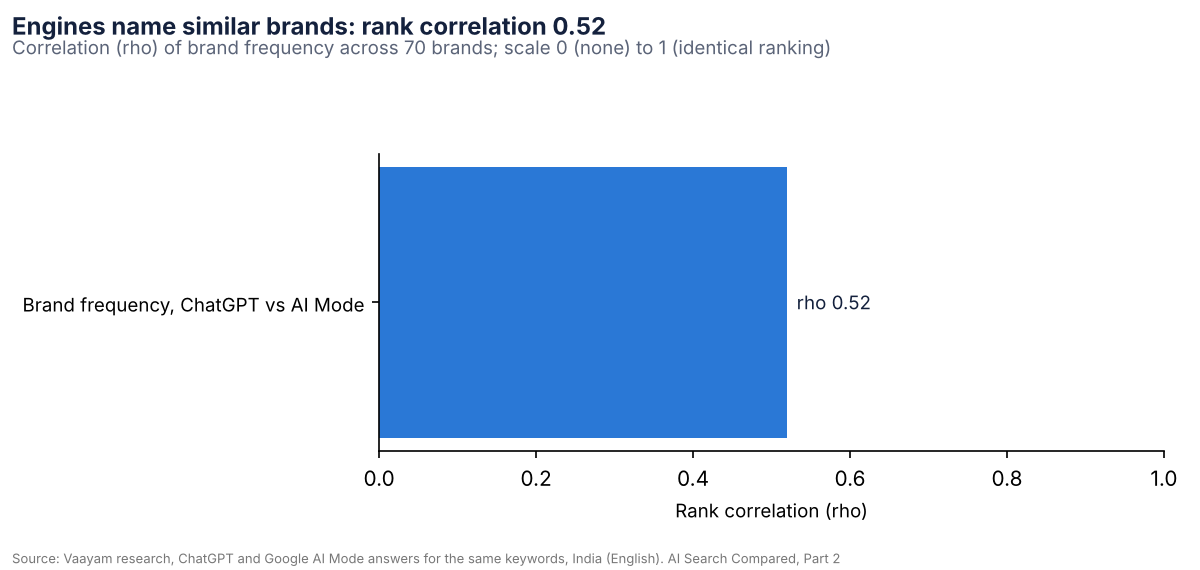
- Brand frequency in the two engines correlates at rho 0.52 across 70 brands, so they name similar brands while citing different pages.
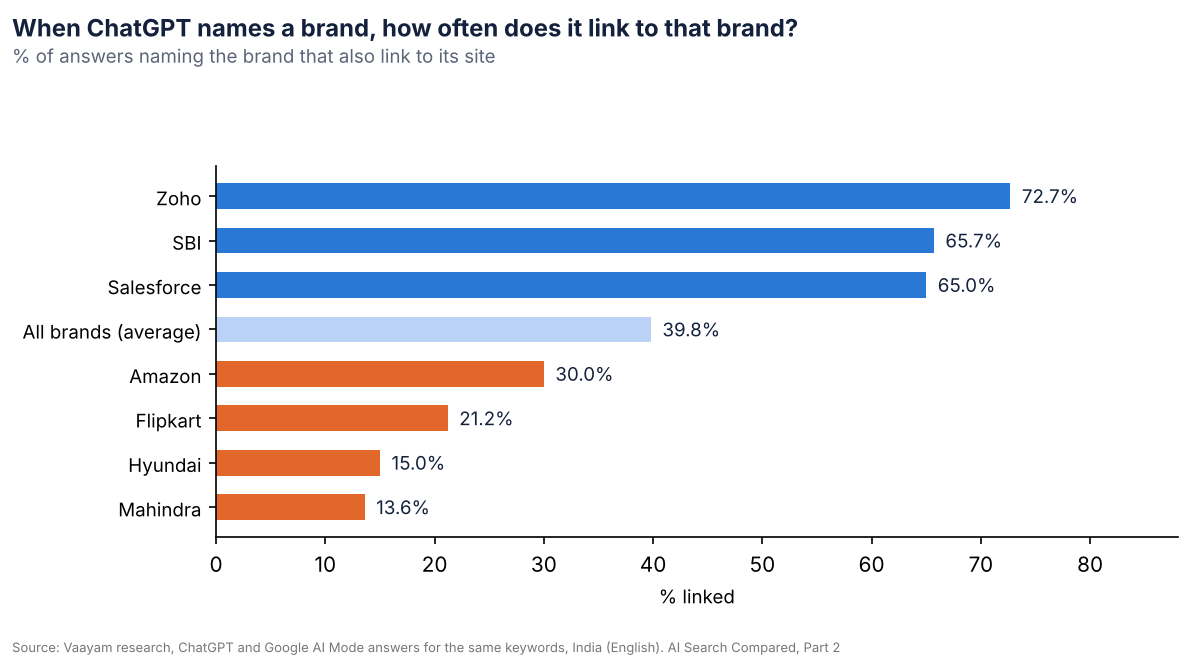
- When ChatGPT names a brand, it links to that brand's site 39.8% of the time. Zoho (72.7%), SBI (65.7%) and Salesforce (65.0%) are linked most often. Amazon (30.0%), Flipkart (21.2%), Hyundai (15.0%) and Mahindra (13.6%) are linked least.
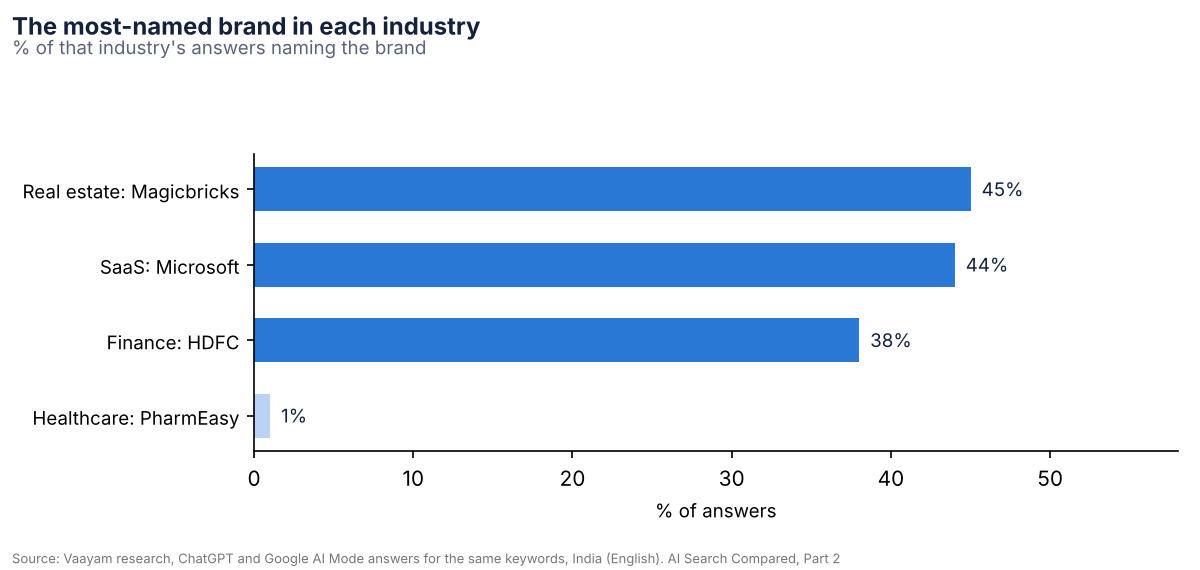
- The most-named brand by industry: Magicbricks in Real estate (45% of answers), Microsoft in SaaS (44%) and HDFC in Finance (38%). No brand dominates Healthcare (PharmEasy 1%).
1. Why the way you count mentions matters
Before comparing engines, the counting rule matters. ChatGPT often labels its links with a bare domain, and 37% of its link labels are of that kind. If those labels are counted as brand mentions, a site that is merely cited looks like a brand that is discussed, and ChatGPT's brand figures are inflated. We counted only the brand's name in the answer's own words. Anyone comparing brand visibility across engines should check that their tool does the same.
2. Both engines name a brand in under half of answers
46.2% of ChatGPT answers name at least one brand, against 44.3% for AI Mode. Both name under one brand per answer on average: 0.89 for ChatGPT and 0.81 for AI Mode. On brand mentions alone, the two engines look very alike.
3. The top brands are almost identical
The most-named brands in ChatGPT are Amazon (6.0%), Microsoft (4.8%), Magicbricks (4.5%), HDFC (4.0%) and SBI (3.5%). AI Mode names the same brands at close to the same rates: 6.7%, 3.7%, 4.4%, 3.9% and 3.1%. A brand that is prominent in one engine tends to be prominent in the other.
4. Brand frequency correlates at 0.52
Across 70 brands, the frequency with which each engine names them has a rank correlation of 0.52. That is a moderate, not perfect, agreement: the two engines name broadly similar brands but not identical ones. The engines agree on who to talk about, and the pages they cite differ.
5. Naming a brand is not the same as linking to it
When ChatGPT names a brand, it links to that brand's own site 39.8% of the time. The rate varies widely. Zoho is linked 72.7% of the time it is named, SBI 65.7% and Salesforce 65.0%. Amazon is linked 30.0%, Flipkart 21.2%, Hyundai 15.0% and Mahindra 13.6%. Large marketplaces and automotive brands are named often but linked rarely, while some software vendors and banks are named and linked together.
6. Which brand leads varies by industry
The most-named brand differs by industry. Magicbricks appears in 45% of Real estate answers, Microsoft in 44% of SaaS answers and HDFC in 38% of Finance answers. In Healthcare no brand dominates: the most-named, PharmEasy, appears in only 1%. In Real estate, SaaS and Finance, one or two brands own the conversation. In Healthcare it is open.
Takeways:
Track mentions and links separately, in each engine. A brand that is named is not necessarily linked, and ChatGPT links to the named brand only 39.8% of the time. Check how your tracking tool counts mentions, and make sure it does not treat a bare-domain link label as a brand mention.
Check whether you are named and linked in both engines for your priority queries. If you are in Real estate, SaaS or Finance, expect a few brands to take most mentions, so measure yourself against the leaders. If you are in Healthcare, the field is open, because no brand dominates. If you are a marketplace or automotive brand, publish clear product and comparison pages that an answer can link to, since being named is not enough.
Report brand mentions and brand links as two separate measures for each engine. Mentions look similar across engines (46.2% and 44.3%), but the pages cited differ sharply, so a brand can look equally visible and still receive very different traffic. These findings come from a correlation study, so validate them against your own category before changing budgets.
Read more from our India search research
ChatGPT vs Google AI Mode: they share only 7.6% of cited pages - how the two engines cite different sources.
Do brands own their name in Google AI Mode? - whether brands appear for their own name in AI Mode.
Named but not cited: the brands Google AI Mode mentions and doesn't link to - mentions versus citations by brand and industry.
Method and limits
We compared the brand names that ChatGPT and Google AI Mode use in their own words in answers to the same keywords in India (English). A mention is the brand's name in the answer text. Citation labels, including bare domains, do not count as mentions. A link means the answer cites the named brand's own site. Brand frequency is the share of answers naming the brand, and the rank correlation covers 70 brands. Percentages and the correlation are the primary figures. Brand-level results rest on smaller samples than the overall figures. Answers from both engines can vary from run to run, as our stability study showed, so single-snapshot figures should be read with that noise in mind. Every finding is a correlation and none show causation.