ChatGPT vs Google AI Mode: they share only 7.6% of cited pages
If you rank well for AI Mode, are you also visible in ChatGPT? We asked the same 1,000 keywords in both and compared what each engine cites. The overlap is small, and the difference is not random noise.

Vaayam research | AI Search Compared, Part 1 | Part 12 of our India search research
This post starts a new series, AI Search Compared, which puts the main AI answer engines side by side. Until now our research looked inside Google: how the AI Overview and AI Mode differ, the anatomy of an AI Mode answer and the domains winning AI Mode in India. Many teams now ask a wider question: if Google AI Mode cites us, does ChatGPT? To answer it we asked the same 1,000 keywords in both engines and compared the sources each one cited.
Key findings
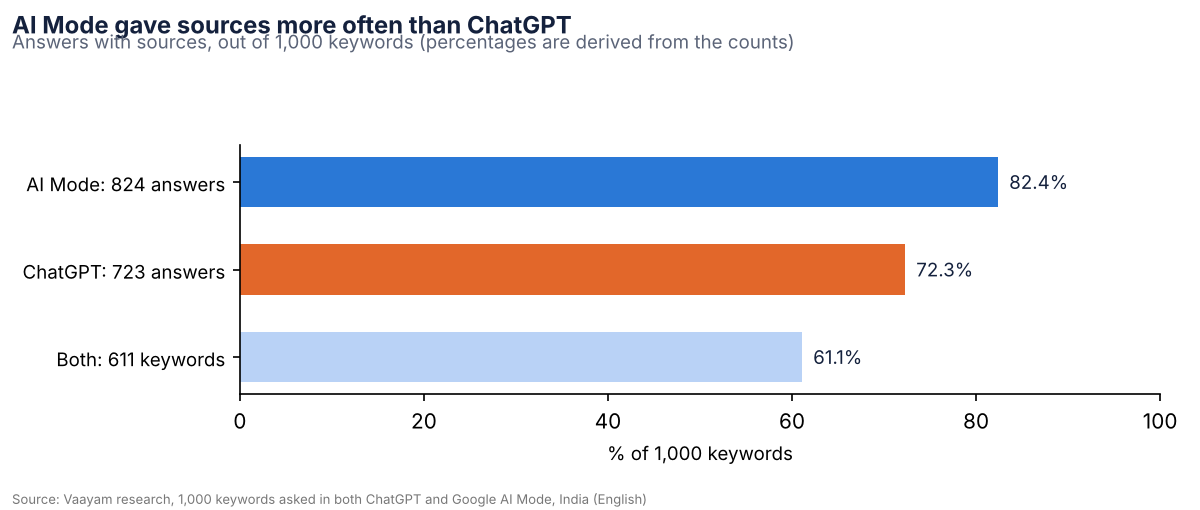
- ChatGPT gave sources on 723 of 1,000 answers and AI Mode on 824. 611 keywords have sources from both.
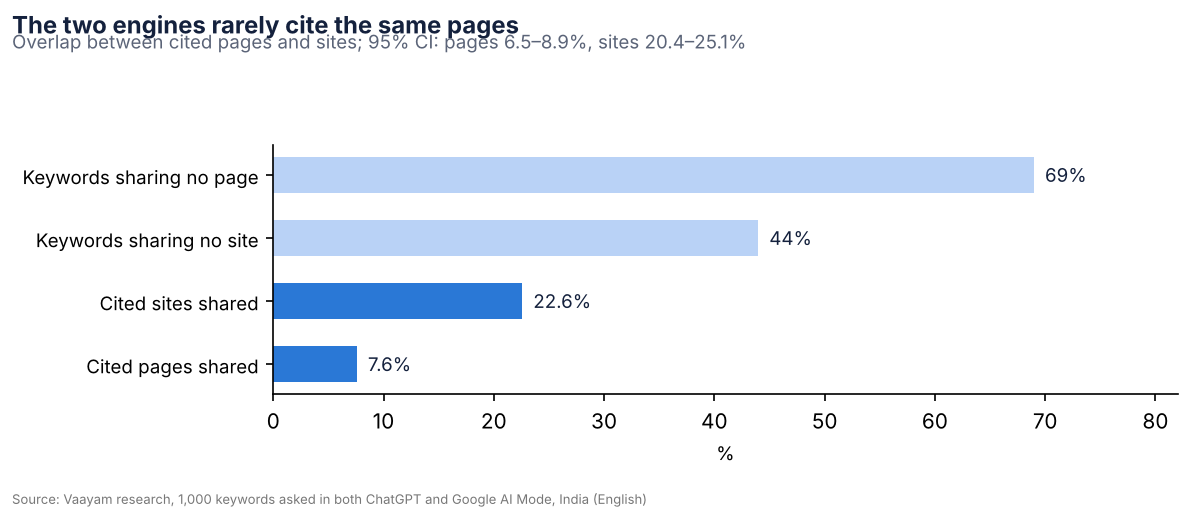
- The engines share 7.6% of cited pages (95% confidence interval 6.5 to 8.9) and 22.6% of cited sites (20.4 to 25.1). 69% of keywords share no page at all, and 44% share no site.
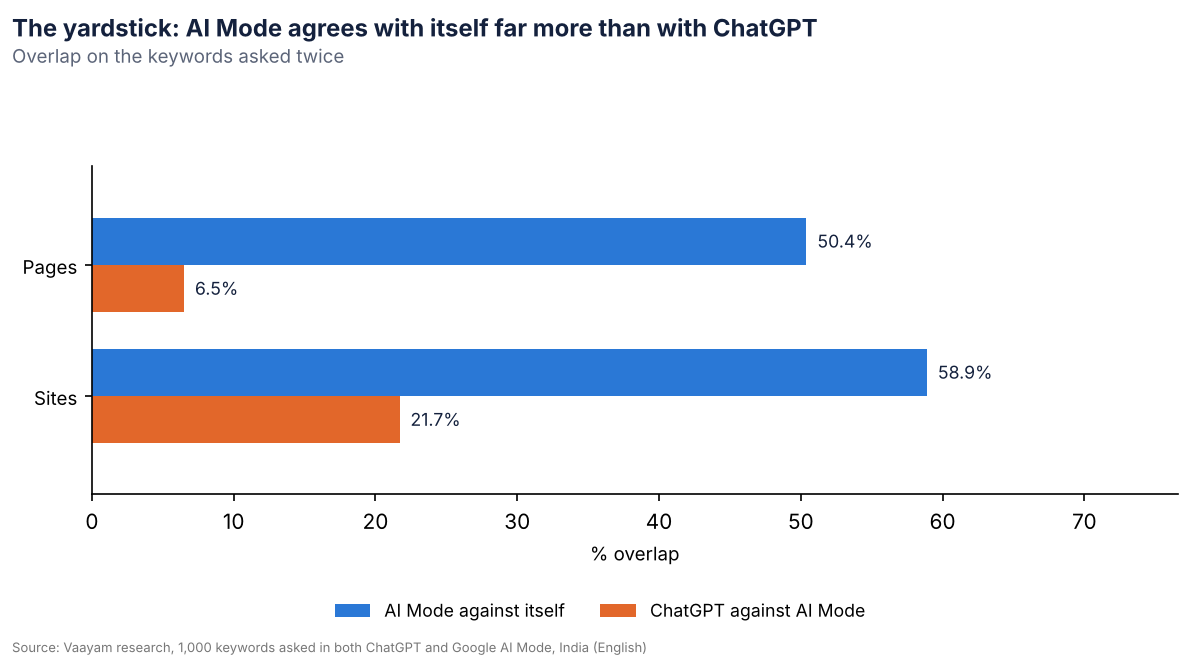
- The yardstick: on keywords asked twice, AI Mode agrees with itself on 50.4% of pages and 58.9% of sites. ChatGPT against AI Mode on those keywords is 6.5% and 21.7%.
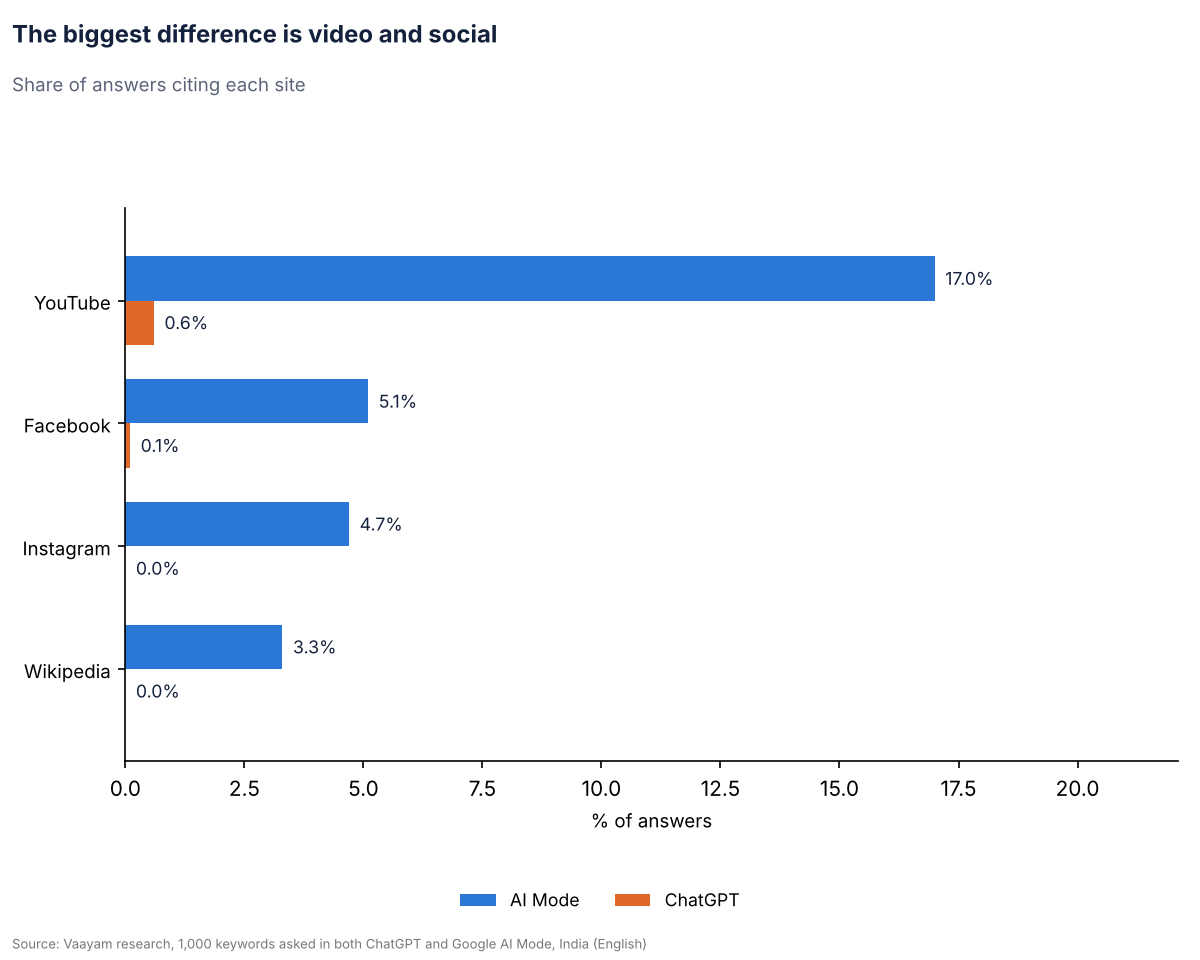
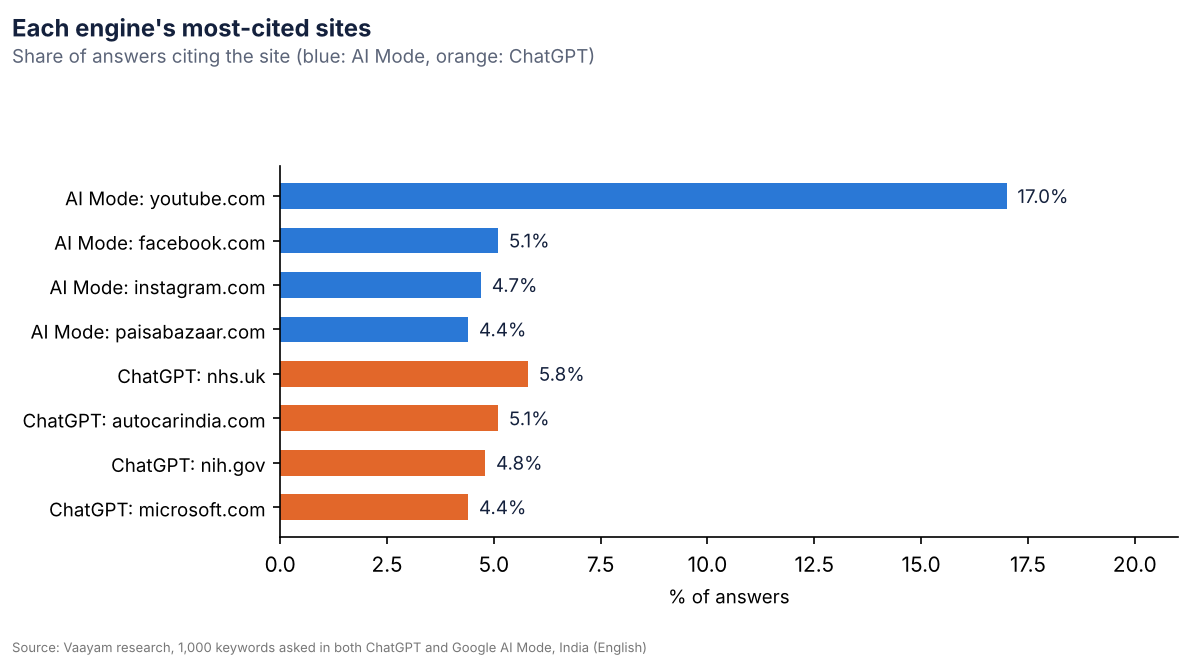
- The biggest difference is video and social. YouTube appears in 17.0% of AI Mode answers and 0.6% of ChatGPT answers. Facebook is 5.1% against 0.1%, Instagram 4.7% against 0.0% and Wikipedia 3.3% against 0.0%.
- ChatGPT's most-cited sites are nhs.uk (5.8%), autocarindia.com (5.1%), nih.gov (4.8%) and microsoft.com (4.4%). AI Mode's are youtube.com, facebook.com, instagram.com and paisabazaar.com (4.4%).
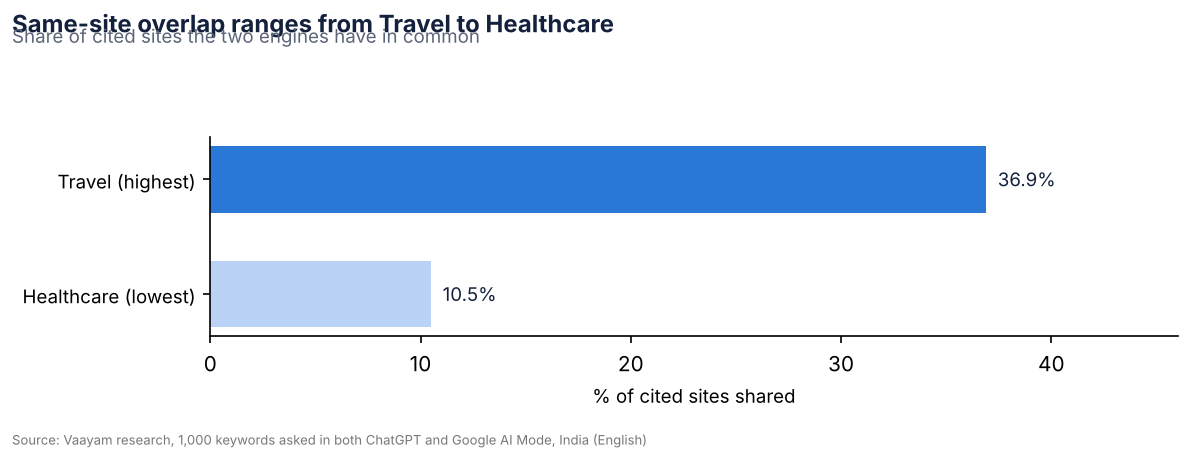
- Same-site overlap runs from 36.9% in Travel to 10.5% in Healthcare.
1. Both engines usually show sources, but not on the same keywords
ChatGPT gave sources on 723 of the 1,000 answers, and Google AI Mode on 824. 611 keywords have sources from both engines, so for roughly four in ten keywords at least one engine gave no sources, and a direct comparison is only possible on the 611 that did. If you track AI visibility, source coverage itself differs between the engines.
2. They share 7.6% of cited pages and 22.6% of cited sites
Across the keywords where both engines cited sources, they share only 7.6% of cited pages (95% confidence interval 6.5 to 8.9) and 22.6% of cited sites (20.4 to 25.1). For 69% of keywords the two engines cite no page in common, and for 44% they cite no site in common. A page that earns a citation in one engine is far more likely to be absent from the other than present in both.
3. The yardstick: is the gap just randomness?
AI answers change from run to run, so a fair question is whether low overlap just reflects that. To check, we compared AI Mode against itself on the keywords asked twice. AI Mode agrees with itself on 50.4% of pages and 58.9% of sites. ChatGPT against AI Mode on those same keywords agrees on only 6.5% of pages and 21.7% of sites. Even AI Mode's own run-to-run variation leaves far more overlap than the gap between the two engines, so the difference is real and not just noise.
4. The biggest difference is video and social
The sharpest contrast is in the type of source. YouTube is cited in 17.0% of AI Mode answers and 0.6% of ChatGPT answers. Facebook is 5.1% against 0.1%, Instagram 4.7% against 0.0% and Wikipedia 3.3% against 0.0%. AI Mode leans on platforms and video, while ChatGPT in this sample almost never cites them. If video and social content is your route into AI answers, that route works in AI Mode but, on this evidence, not in ChatGPT.
5. Each engine has its own favourite sites
ChatGPT's most-cited sites are nhs.uk (5.8%), autocarindia.com (5.1%), nih.gov (4.8%) and microsoft.com (4.4%): health institutions, a specialist automotive publication and a technology vendor's own site. AI Mode's most-cited sites are youtube.com (17.0%), facebook.com (5.1%), instagram.com (4.7%) and paisabazaar.com (4.4%): video, social platforms and a finance comparison site. The two lists have almost nothing in common.
6. Overlap varies by industry
Same-site overlap runs from 36.9% in Travel to 10.5% in Healthcare. In Travel the two engines draw on more of the same sites. In Healthcare they draw on largely different ones, which matches ChatGPT's reliance on institutions such as nhs.uk and nih.gov.
Key Takeaways
Track the two engines separately - Do not assume that a citation in Google AI Mode means a citation in ChatGPT: only 7.6% of cited pages are shared. For AI Mode, video and social presence matters, with YouTube cited in 17.0% of answers. For ChatGPT, authoritative institutional and specialist sources lead the list, so authority and original information matter more than platform presence.
Check both engines for your priority queries and note where you appear in one and not the other. In Healthcare, where overlap is lowest, you may need two separate plans. In Travel, where overlap is highest, work for one engine is more likely to carry over.
Report AI visibility per engine, not as one number. The 'AI Mode against itself' yardstick shows the gap between engines is far larger than run-to-run variation. These findings come from a 1,000-keyword correlation snapshot, so validate them against your own category before changing budgets.
Read more from our India search research
AI Overview vs AI Mode: two answers, two sets of sources - how Google's two AI surfaces cite different pages.
Anatomy of a Google AI Mode answer in India - length, structure, sources and ads in AI Mode answers.
The domains winning Google AI Mode in India - the most-cited domains and who gains and loses.
Method and limits
We asked the same 1,000 keywords in ChatGPT and in Google AI Mode in India (English) and recorded the sources each cited. This sample is separate from, and smaller than, the 9,734-keyword dataset used in our earlier posts. ChatGPT gave sources on 723 answers and AI Mode on 824, and overlap is measured on keywords where both gave sources. Some keywords were asked twice so that we could measure AI Mode against itself as a yardstick. Answers from both engines can vary from run to run, and a single snapshot may not reflect what an individual user sees. Every finding is a correlation and none show causation.