The domains winning Google AI Mode in India
More than a quarter of AI Mode citations never leave Google, YouTube out-cites every other site by a wide margin, and a handful of niche publishers are cited far above their organic weight. We analysed AI Mode answers for 9,734 keywords to see who is actually being cited.

Vaayam research | Data collected 26 September 2026 | Part 5 of a series
This is the fifth post in our India search series. We started with why the ten blue links are almost gone, then showed that every industry gets a different Google and that Google builds a different page for each intent. Last time we asked whether Google rankings predict AI visibility and found that rank helps but is far from the whole story. This post answers the obvious follow-up: if rank is not the whole story, who is winning AI Mode citations? We looked at the sources cited in Google AI Mode answers for 9,734 keywords across 10 industries.
Key findings
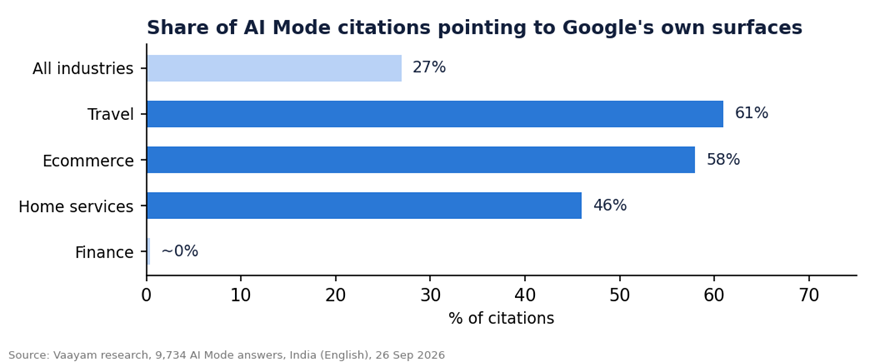
- 27% of AI Mode citations point to Google's own surfaces rather than websites. Travel sends 61% of its citations there, Ecommerce 58%, Home services 46%, and Finance about 0%.
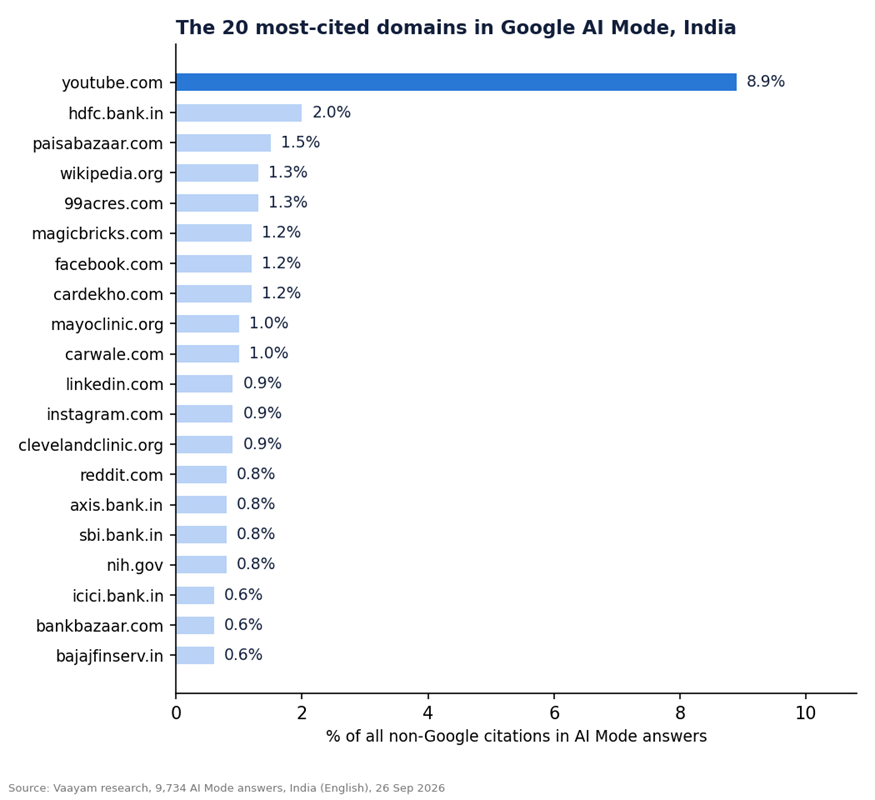
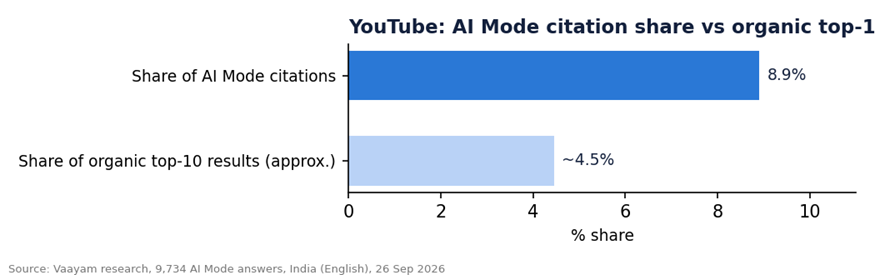
- YouTube is the most-cited domain by far: 8.9% of non-Google citations, about 2× its share of organic top-10 results.
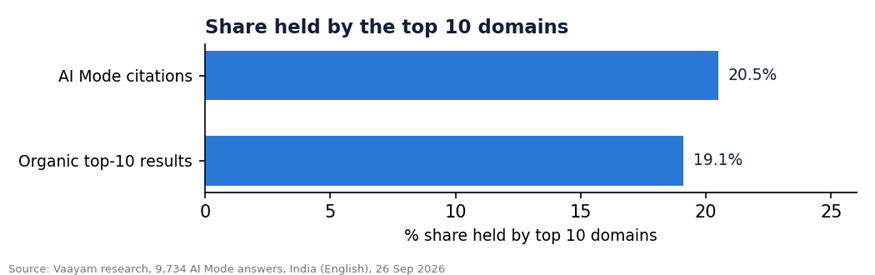
- Concentration is similar to organic search: the top 10 domains take 20.5% of AI citations and 19.1% of organic top 10 results.
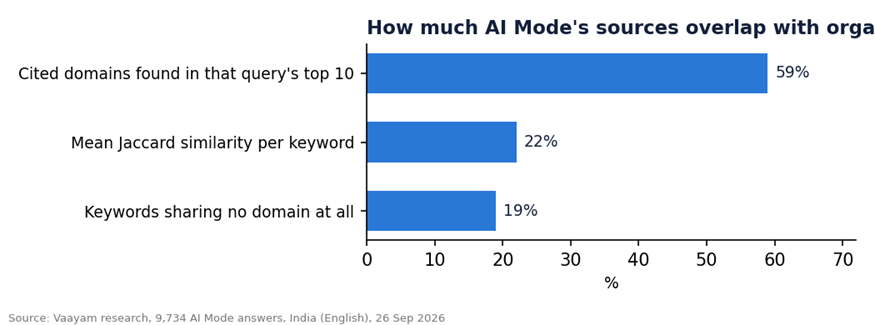
- Overlap with organic is partial: the mean Jaccard similarity is 22%, 59% of cited domains sit in that query's top 10, and 19% of keywords share no domain at all.
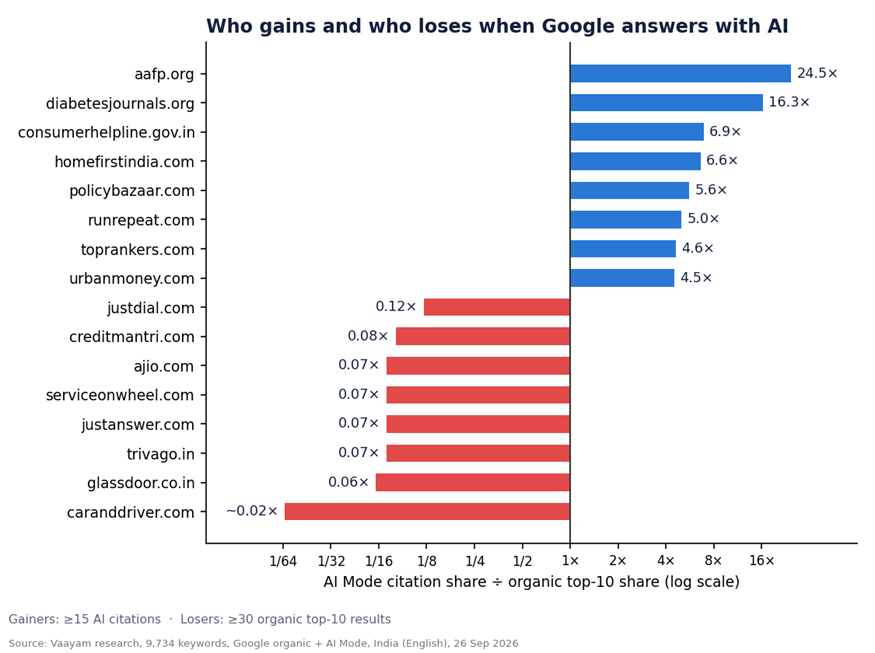
- Gainers include aafp.org, diabetesjournals.org, consumerhelpline.gov.in and policybazaar.com; losers include justdial.com, ajio.com, trivago.in and glassdoor.co.in.
1. More than a quarter of AI Mode citations stay inside Google
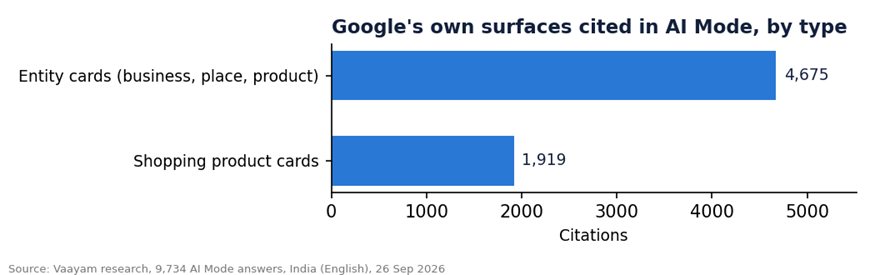
Before we get to the websites, a number every brand should see: 27% of AI Mode citations point to Google's own surfaces rather than to an external site. Most are entity cards for a business, place or product (4,675 citations), followed by Shopping product cards (1,919). For anyone optimising for AI Mode visibility, this means a meaningful share of the "citation pie" is not a website at all, and the only way into it is through Google Business Profile, Merchant Center and similar feeds.
The share depends heavily on industry. Travel sends 61% of its AI Mode citations to Google surfaces, Ecommerce 58% and Home services 46%. Finance sits at about 0%: for money questions, AI Mode cites websites almost exclusively. If you are in a local or product category, your AI Mode strategy has to include your Google-owned listings, not just your pages.
2. YouTube is the most-cited domain in Google AI Mode
Setting Google's own surfaces aside, YouTube is the most-cited domain in AI Mode by a wide margin, with 8.9% of non-Google citations. The next domains in the top 10 are hdfc.bank.in, paisabazaar.com, wikipedia.org, 99acres.com, magicbricks.com, facebook.com, cardekho.com, mayoclinic.org and carwale.com. The list is a useful snapshot of what AI Mode treats as authoritative: banks and comparison sites for finance, property portals for real estate, car marketplaces for automotive, and medical institutions for health.
YouTube's lead is not just a reflection of its organic footprint. Its share of AI Mode citations is roughly twice its share of organic top 10 results, so video content is being pulled into AI answers more often than classic rankings would predict. If video is not part of your content plan, your competitors' video is likely filling that gap.
3. AI citations are as concentrated as organic search
A common worry is that AI answers will funnel attention to a tiny set of sites. The data suggests concentration is broadly similar to organic search. The top 10 domains take 20.5% of AI Mode citations, against 19.1% of organic top-10 results. AI Mode is not meaningfully more winner-takes-all than the results page it sits beside; it is just a different set of winners.
4. AI Mode and organic results only partly overlap
On a per-keyword basis, the mean Jaccard similarity between the domains AI Mode cites and the organic top-10 domains is 22%. 59% of cited domains do appear in that query's organic top 10, so ranking still gives you a real foothold, but 19% of keywords share no domain at all between the two lists. This lines up with our earlier finding that most pages AI Mode cites do not rank in the top 20. Organic rank and AI citation overlap, but they are two different visibility problems.
5. The biggest gainers and losers when Google answers with AI
To see who benefits from the shift, we compared each domain's share of AI Mode citations with its share of organic top-10 results. Gainers, among domains with at least 15 AI citations, include aafp.org (about 24×), diabetesjournals.org (about 16×), consumerhelpline.gov.in (about 7×) and policybazaar.com (about 5.6×). These are specialist, authoritative sources, often medical, governmental or deep in a single vertical. Losers, among domains with at least 30 organic top-10 results, include justdial.com, creditmantri.com, ajio.com, serviceonwheel.com, justanswer.com, trivago.in, glassdoor.co.in, and caranddriver.com: directories, marketplaces and aggregators that rank well organically but are cited far less in AI answers.
What to do with this data
Add AI Mode citation share to your reporting for each priority keyword set, and treat YouTube as a citation channel, not just a traffic channel. In Travel, Ecommerce and Home services, put real effort into the Google-owned surfaces (Business Profile, Merchant Center, product feeds) since they take 46–61% of citations in those categories.
The gainers list shows that narrow, authoritative, primary-source content gets cited well above its organic weight. If you are a directory, marketplace, or aggregator, your organic strength is not translating into AI citation at the same rate, so plan for a channel mix that does not depend on the top 10 alone.
Do not assume AI search will reshuffle everything. Concentration is similar to organic, and 59% of cited domains are still in the top 10. What changes is the shape of the winners: more video, more specialist sources, and a large share of citations that go to Google itself. These findings are correlations from a single snapshot, so test them against your own category before reallocating budget.
Read the rest of the series
Part 1: The 10 blue links are almost gone - why only 4.8% of Google page 1s in India still show ten organic results.
Part 2: Every industry gets a different Google - how Feature Density and specific SERP features vary by industry.
Part 3: Google builds a different page for each intent - how informational, commercial, transactional, and navigational searches each get a different page.
Part 4: Do Google rankings predict AI visibility? - How organic rank relates to AI Mode citations.
Method and limits
The dataset covers 9,734 keywords across 10 industries, each with a Google organic SERP (depth 20) and a Google AI Mode answer, collected on 26 September 2026 for India in English on desktop. Domain-level shares exclude Google's own surfaces. The snapshot is non-personalised and covers a single day, so individual users may see different results. Every finding is a correlation, and none show causation.