How stable is Google AI Mode? Ask twice and only half the cited pages match
If you measure your AI visibility once, how much of what you see is real? We asked Google AI Mode the same question twice, minutes apart, and again five weeks later. About half of the difference is noise, and a further chunk is genuine change.

Vaayam research | How stable is AI Mode? | Part 13 of our India search research
Every AI visibility report is a snapshot. Before you act on one, it helps to know how much a snapshot moves on its own. In earlier posts we compared the AI Overview and AI Mode, looked at the anatomy of an AI Mode answer and compared ChatGPT with Google AI Mode, where we used a same-day repeat as a yardstick. This post explains that yardstick in full and then adds the longer view: how far AI Mode's sources change over five weeks.
Key findings
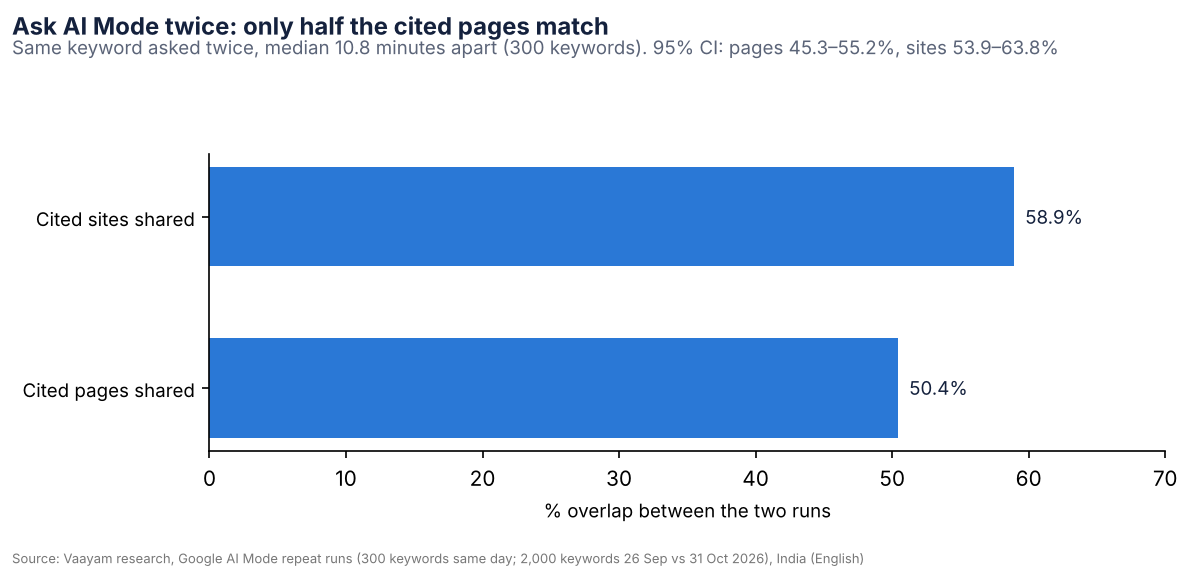
- Asked the same question twice, a median of 10.8 minutes apart, only 50.4% of cited pages overlap (95% CI 45.3 to 55.2) and 58.9% of sites (53.9 to 63.8). The test covers 300 keywords, 235 with sources both times.
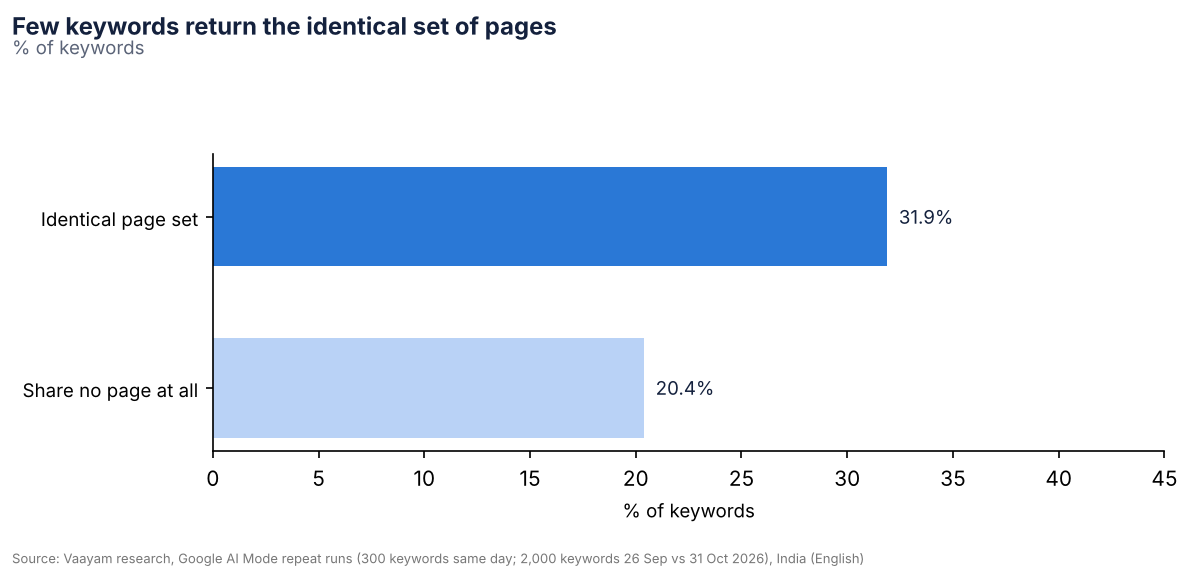
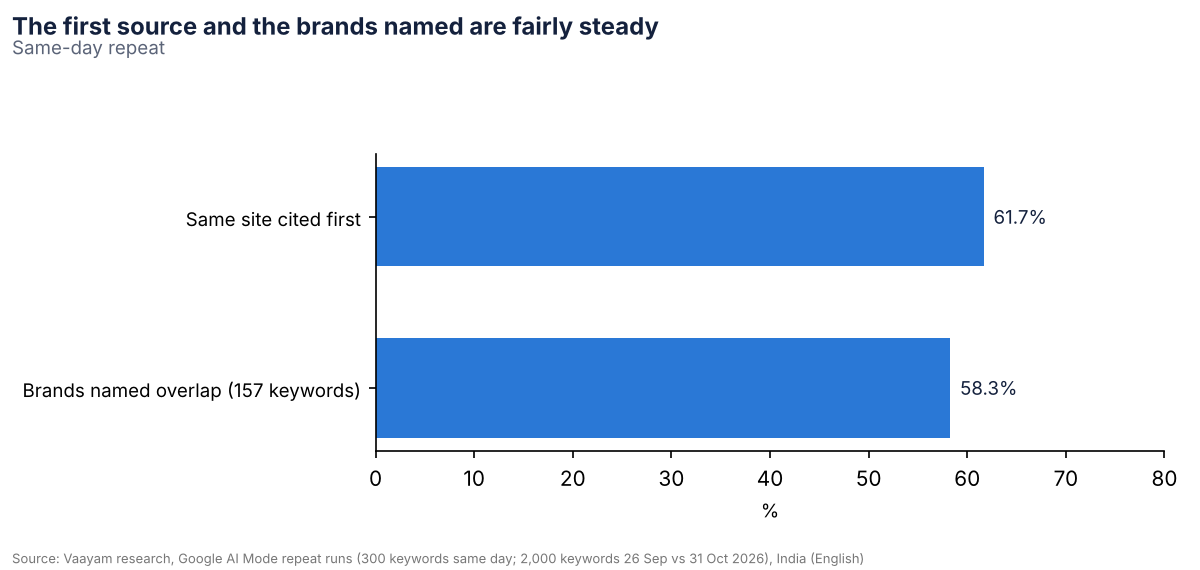
- 31.9% of keywords return an identical page set. 20.4% share no page at all. The same site is cited first 61.7% of the time.
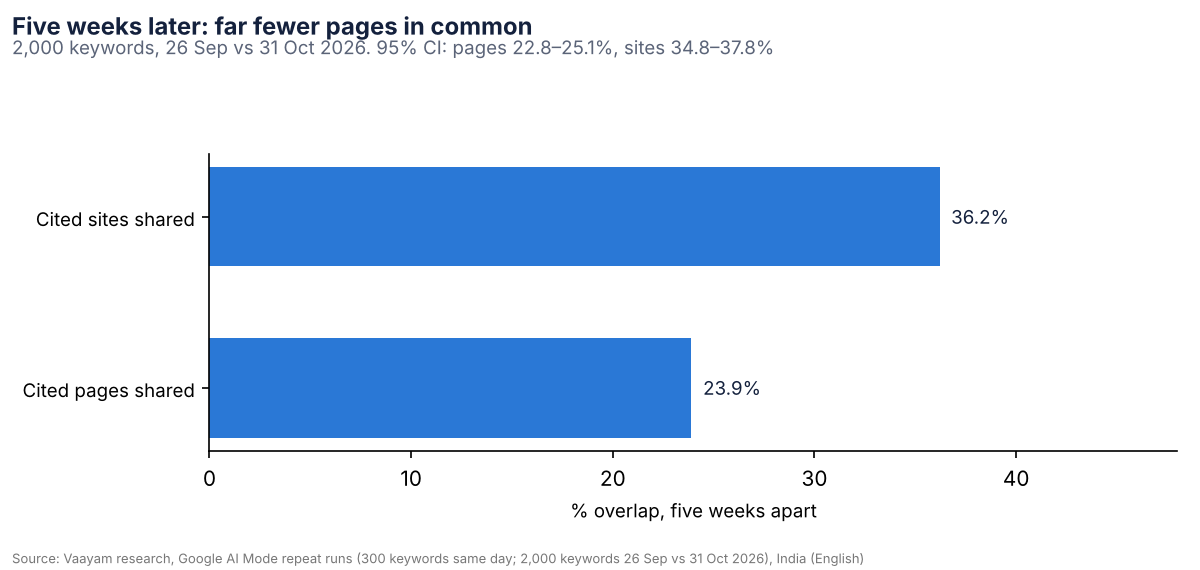
- Five weeks later, across 2,000 keywords (1,514 with sources both times), 23.9% of pages overlap (CI 22.8 to 25.1) and 36.2% of sites (34.8 to 37.8).
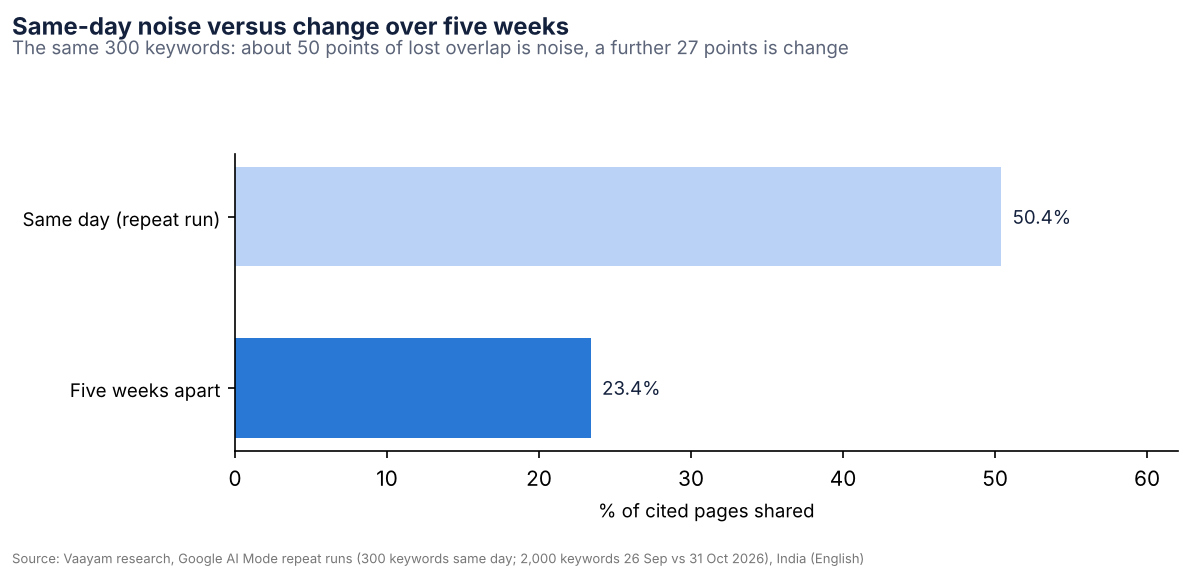
- On the 300 keywords with both tests: 50.4% overlap on the same day and 23.4% five weeks apart. About 50 points of lost overlap is same-day noise, and a further 27 points is change over five weeks.
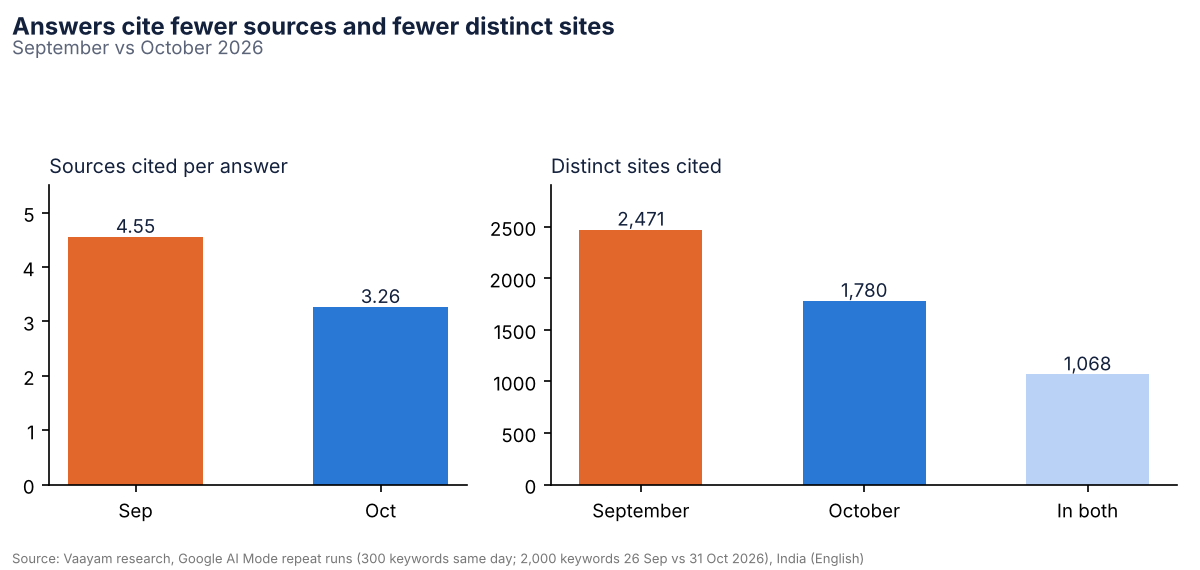
- Answers cite fewer sources: 4.55 per answer in September against 3.26 in October. Distinct sites fell from 2,471 to 1,780.
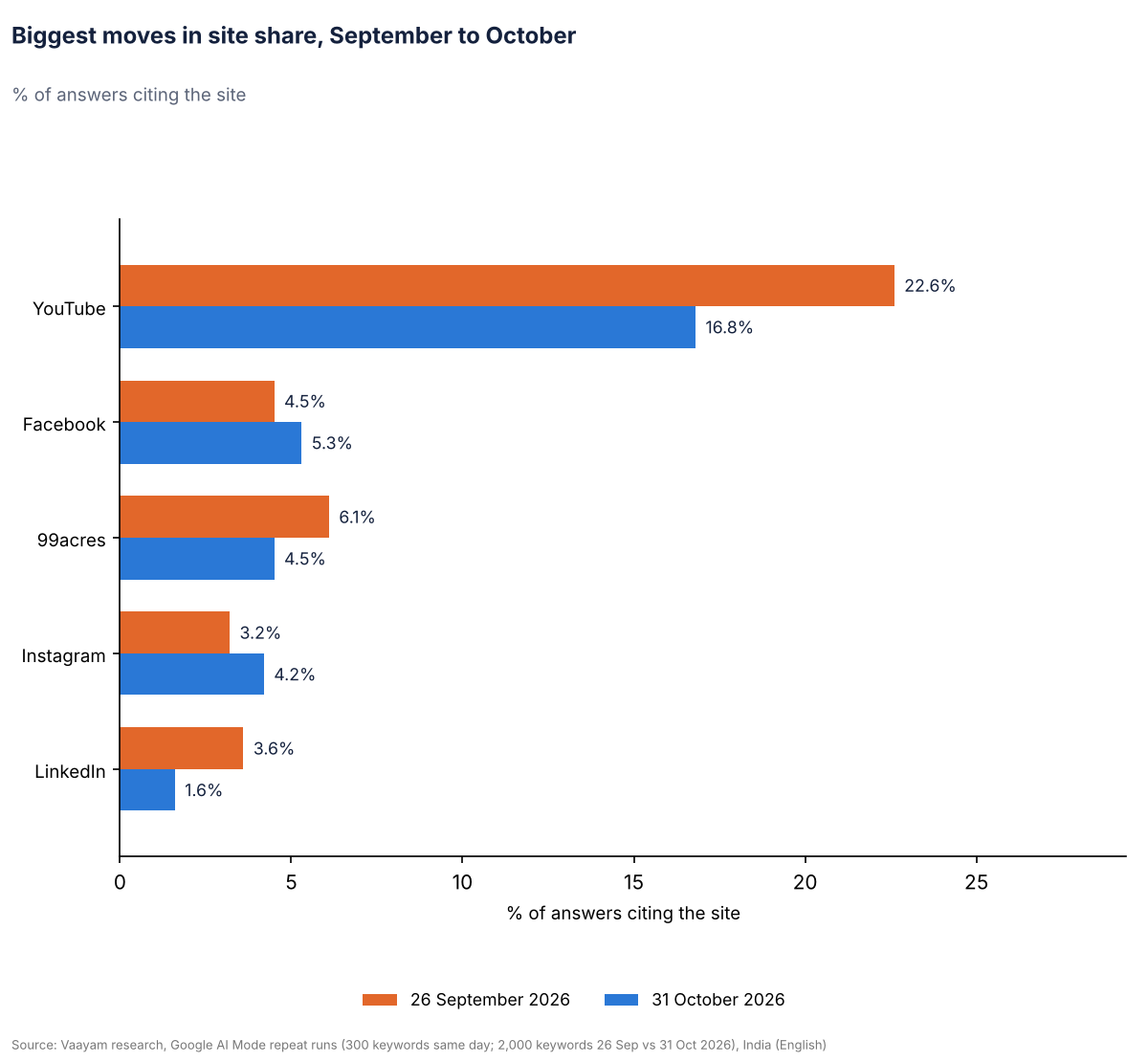
- YouTube fell from 22.6% to 16.8% of answers, and LinkedIn from 3.6% to 1.6%. Instagram (3.2% to 4.2%) and Facebook (4.5% to 5.3%) rose.
Part A: Ask AI Mode the same question twice
1. Only half the cited pages are the same
We asked 300 keywords twice, a median of 10.8 minutes apart. 235 of them returned sources both times. On those, only 50.4% of cited pages overlap (95% confidence interval 45.3 to 55.2), and 58.9% of cited sites (53.9 to 63.8). In other words, two runs of the same question a few minutes apart disagree on roughly half of the pages they cite.
2. Few keywords return an identical set of pages
Only 31.9% of keywords return an identical page set on the second run, and 20.4% share no page at all. A single run is one draw from a spread of possible answers, not a fixed result.
3. The first source and the brands named are steadier
Some parts of the answer are steadier than the page list. The same site is cited first 61.7% of the time. Brands named overlap by 58.3% (157 keywords).
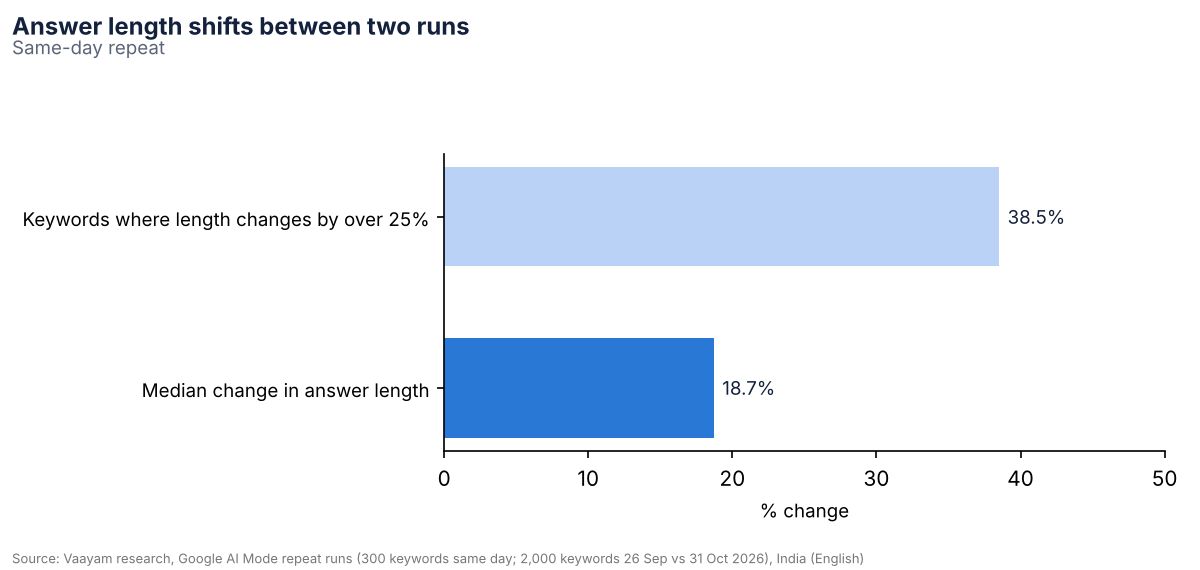
Answer length also moves. It changes by a median of 18.7% between the two runs, and by more than 25% on 38.5% of keywords.
4. Steadiness differs by industry, with a caveat
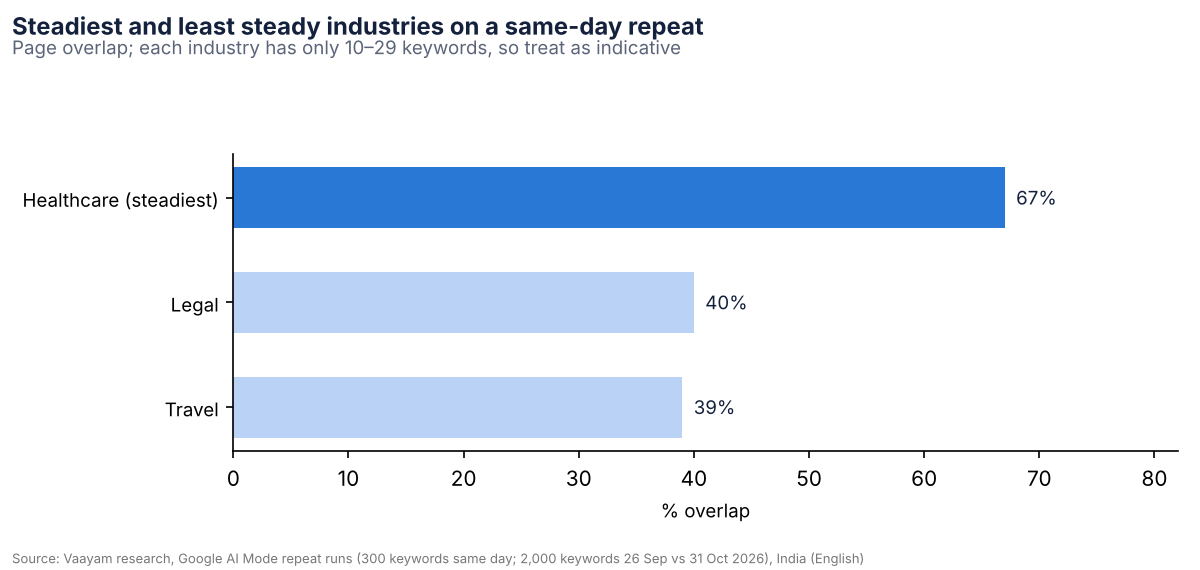
Healthcare is the steadiest industry in the same-day test, at 67% page overlap. Legal (40%) and Travel (39%) are the least steady. Each industry has only 10 to 29 keywords here, so treat these as indications, not firm rankings.
Part B: Five weeks later
5. After five weeks, only 23.9% of pages are the same
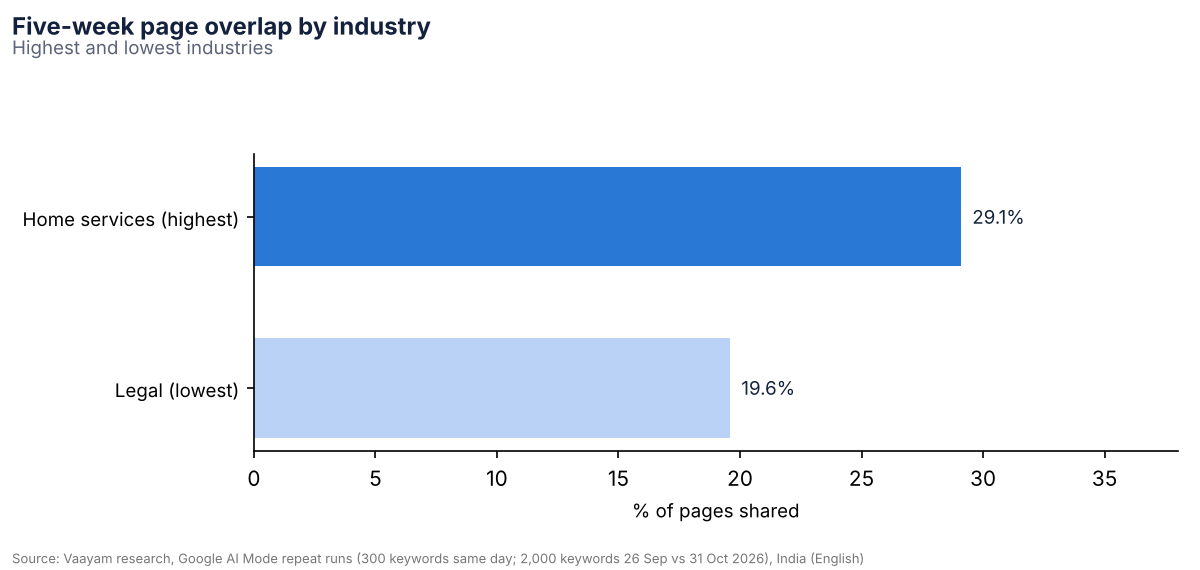
We then compared 2,000 keywords asked on 26 September 2026 and again on 31 October 2026. 1,514 returned sources both times. On those, 23.9% of cited pages overlap (95% CI 22.8 to 25.1) and 36.2% of cited sites (34.8 to 37.8). Page overlap runs from 29.1% in Home services to 19.6% in Legal.
6. How much is noise, and how much is change?
The 300 keywords that also have a same-day repeat let us separate the two. On those keywords, 50.4% of pages overlap on the same day and 23.4% five weeks apart. About 50 points of lost overlap is same-day noise, which is the loss you get even when nothing has changed. A further 27 points is change over five weeks. A fair reading is that roughly two thirds of the apparent difference between two snapshots five weeks apart is the sampling noise of a single run, which is why single snapshots need care.
7. Answers cite fewer sources
Answers cite fewer sources in October. The average answer cited 4.55 sources in September and 3.26 in October, a fall of about 28%. Distinct sites cited fell from 2,471 to 1,780, also about 28%, and 1,068 sites appear in both months. That is roughly 43% of September's sites and 60% of October's.
8. The biggest moves in site share
Measured as the percentage of answers citing the site, YouTube fell from 22.6% to 16.8% and LinkedIn from 3.6% to 1.6%. 99acres fell from 6.1% to 4.5%. Instagram rose from 3.2% to 4.2% and Facebook from 4.5% to 5.3%. Some of these moves may be genuine, such as the general fall in sources per answer, and some may be within the noise we measured, so the smaller shifts in particular should be read with caution.
Key Takeaways
Never act on a single AI Mode snapshot. Run each priority keyword more than once and report an average or a range, since two runs minutes apart share only about half of their cited pages. Track whether you are cited across runs, not whether you appeared in one.
Expect your AI Mode citations to move even if you change nothing. Sites are steadier than pages (58.9% against 50.4% on the same day), so measure brand presence at the site level first. Treat small week-to-week swings as noise, and look for movements that persist.
Ask your reporting team for the noise level behind every AI visibility chart. With answers citing fewer sources over time, the same number of citations may represent a larger share of a smaller pool. These findings come from a correlation study, so validate them against your own keywords before changing budgets.
Read more from our India search research
AI Overview vs AI Mode: two answers, two sets of sources - how Google's two AI surfaces cite different pages.
Anatomy of a Google AI Mode answer in India - length, structure, sources and ads in AI Mode answers.
ChatGPT vs Google AI Mode: they share only 7.6% of cited pages - how the two engines cite different sources.
Method and limits
Same-day test: 300 keywords were asked in Google AI Mode twice, a median of 10.8 minutes apart, and 235 returned sources both times. Five-week test: 2,000 keywords were asked on 26 September 2026 and again on 31 October 2026, and 1,514 returned sources both times. Overlap is measured on keywords with sources in both runs. These samples are separate from, and smaller than, the 9,734-keyword dataset used in some of our earlier posts. Because AI Mode answers vary from run to run, the single-snapshot figures in our other posts, especially page-level ones, should be read with this noise in mind. Every finding is a correlation and none show causation.